










































Communication for Social Change Anthology: Historical and Contemporary Readings
Image
SummaryText
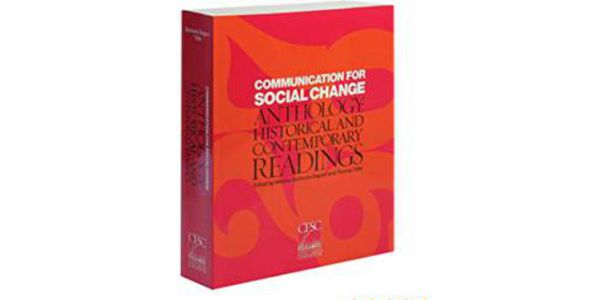
Published by the Communication for Social Change (CFSC) Consortium, this anthology brings together thinking by more than 150 communication for social change experts to review the evolution of communication for social change from the early 1960's to the present. This collection of approximately 200 texts looks at where the field has been and where it is headed, as well as the principles that have characterised communication for social change from the beginning.
The editorial process began with a global call through The Communication Initiative networks in March 2003 seeking suggestions and contributions both for a database of CFSC and development communication texts and for this CFSC anthology. Over 500 responses were received as a result of this initial call. The editors spent two years looking at the evolution of CFSC, reviewing the literature and answering the question: "Which thinkers and writers contributed to the formation of the key ideas and ideals of CFSC?" They consulted with numerous academic leaders from various regions to plan the scope of work, and, through this process, additional suggestions were added to the initial list. Thus, producing the book was an inclusive, participatory effort by many scholars from five continents. The editors worked to find the writings and work of authors who might not be particularly well known in English-speaking countries or in the industrialised world.
This anthology has two parts: historical perspectives and contemporary readings. Beginning in 1927 and ending at 1995, the first part of the book reveals the historical roots of CFSC principles and pioneering thinking. The dominant voices in these earliest years came from North American and European scholars, in no small part due to their ability to write in English, the language used by faculty at the largest and best-funded universities of the time. Even so, the reader of the first part will be introduced to contributions from Asia and Latin America in the earliest years of communication for development. The editors note that for the first time the Anthology offers texts, originally in Spanish, that they feel are as important as those that were produced by scholars in the United States in the sixties and seventies.
The second part showcases texts published since 1995, covering 10 years of contributions to what came, over this time, to be known as the field of communication for social change. Considered by the editors to cover the "current debate", the 80 or so works included in this part are organised thematically within the following sub-headings: Paradigms in Communication for Development; Popular Culture and Identity; Social Movements and Community Participation; Power, Media and the Public Sphere; and Information Society and Communication Rights.
Note: As of June 2019, extra copies of the CFSC Anthology are available in English and Spanish for universities and social change practitioners. Though the publication is free, shipping costs will need to be paid via a certified check, money order, credit card, or Pay Pal. Contact: dgrayfelder@gmail.com to inquire.
The editorial process began with a global call through The Communication Initiative networks in March 2003 seeking suggestions and contributions both for a database of CFSC and development communication texts and for this CFSC anthology. Over 500 responses were received as a result of this initial call. The editors spent two years looking at the evolution of CFSC, reviewing the literature and answering the question: "Which thinkers and writers contributed to the formation of the key ideas and ideals of CFSC?" They consulted with numerous academic leaders from various regions to plan the scope of work, and, through this process, additional suggestions were added to the initial list. Thus, producing the book was an inclusive, participatory effort by many scholars from five continents. The editors worked to find the writings and work of authors who might not be particularly well known in English-speaking countries or in the industrialised world.
This anthology has two parts: historical perspectives and contemporary readings. Beginning in 1927 and ending at 1995, the first part of the book reveals the historical roots of CFSC principles and pioneering thinking. The dominant voices in these earliest years came from North American and European scholars, in no small part due to their ability to write in English, the language used by faculty at the largest and best-funded universities of the time. Even so, the reader of the first part will be introduced to contributions from Asia and Latin America in the earliest years of communication for development. The editors note that for the first time the Anthology offers texts, originally in Spanish, that they feel are as important as those that were produced by scholars in the United States in the sixties and seventies.
The second part showcases texts published since 1995, covering 10 years of contributions to what came, over this time, to be known as the field of communication for social change. Considered by the editors to cover the "current debate", the 80 or so works included in this part are organised thematically within the following sub-headings: Paradigms in Communication for Development; Popular Culture and Identity; Social Movements and Community Participation; Power, Media and the Public Sphere; and Information Society and Communication Rights.
Note: As of June 2019, extra copies of the CFSC Anthology are available in English and Spanish for universities and social change practitioners. Though the publication is free, shipping costs will need to be paid via a certified check, money order, credit card, or Pay Pal. Contact: dgrayfelder@gmail.com to inquire.
Publication Date
Languages
English, Spanish
Number of Pages
1,067 (English)
Source
Email and Skype communication with the editors of this publication, June 22 through July 3 2006; press release from the CFSC Consortium, August 25 2006 and February 15 2007; posting from Denise Gray-Felder to The CI's Social Change Network, June 3 2019; and CFSC Consortium website, October 24 2019.
- Log in to post comments