










































FAMILY SIZE / FERTILITY TRENDS - Social Shakes
The Communication Initiative
Below is part of an overall paper called "SOCIAL SHAKES - rethinking the core principles for principled and effective development action" - the full Table of Contents is here.
FAMILY SIZE / FERTILITY TRENDS
Family size is falling in most countries of the world. See, for example, the right column of the World Bank table for country trends1 and play with the decade data comparisons. There has been a very rapid decline in live births per 100,000 and fertility rates since the 1970s as highlighted in this chart - Birth rates (live births per 1,000 people per year) over the long run – Max Roser2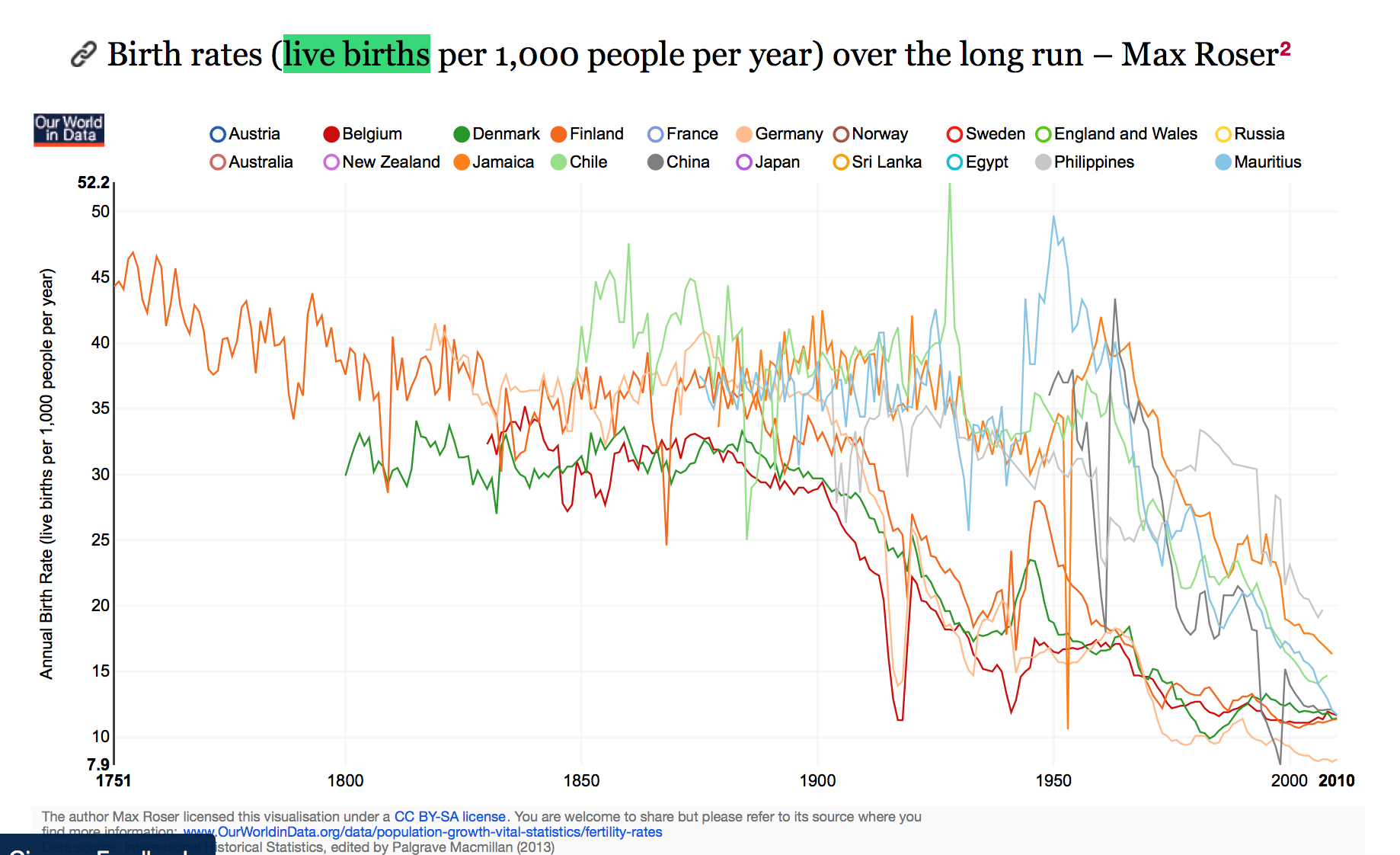
The International Conference on Population and Development (ICPD) in Cairo in 1990 identified why this trend was happening. Participants learned from the 1970s and 1980s and distilled the pathway for future progress. Though it is tempting to credit the product (vastly improved use of contraceptives) as the core reason for family size decrease, some of those contraceptive products and services had been available for a long time with little impact prior to the 1970s. (Others, of course, were new.)
The ICPD identified that a key element for further progress on fertility rate and births per 100,000 was going to be (and turned out to be), what UNFPA summarises as "recognition that reproductive health and rights, as well as women's empowerment and gender equality, are cornerstones of population and development programmes."
There is no vaccine for rights, empowerment, equality and gender. Only communication strategies can move, and have moved, those issues in a positive direction.
Campaigns for the rights of women, initiatives that stressed male responsibility and involvement, the opening up of conversations across media and in other public spaces on often-sensitive sexuality issues, support for conversations within households, the priority focus on girls going to and staying in school, and efforts to create the positive social space for displaying and purchasing contraceptives are just some of the communication processes that proved vitally important in helping to bring down fertility rate and births per 100,000 in so many countries. These processes were not simply oriented to support contraceptive use. Nor were they just a basic supporting environment for condom and birth control use. These social processes are enmeshed with, entangled with, intertwined with, those products. One cannot happen without the other.
1http://data.worldbank.org/indicator/SP.DYN.TFRT.IN?page=6
2 http://ourworldindata.org/data/population-growth-vital-statistics/fertility-rates/
The next section in this paper is TOBACCO.
The previous section in this paper is DRIVING FORCES FOR MAJOR DEVELOPMENT CHANGES.
Editor's note: Above is an excerpt from Warren Feek's paper "SOCIAL SHAKES - rethinking the core principles for principled and effective development action".
The full table of contents for this paper can be accessed at the bottom of the opening page.
Image credit: Chris Morry, The Communication Initiative
- Log in to post comments