










































Using the Airwaves to Empower Quechua Women in Bolivia
IPS News
This news article describes the gender-related work of a network of community stations Educación Radiofónica de Bolivia (Erbol) focusing on improving social conditions through grassroots communication. The work of empowering people in the highland region of the Andes is being carried out, in part, by women. Throughout the department of Cochabamba, women who have never taken a course in radio broadcasting are using the airwaves to inform, empower, and raise awareness and to work for change in their communities.
According to the article, women choose radio as a communication means to discuss the exercise of democracy, social control, gender equality, legal questions, and other issues, based on their experience as indigenous women. They know from experience that "radio is the best way to reach women in their homes in remote rural villages, where television is an inconceivable luxury due to the lack of electricity, and newspapers are impossible to get because of the distances involved." The programming is broadcast in local languages: Quechua, Aymara, or Guaraní, the three most widely spoken native languages in Bolivia, where more than 60 percent of the population of 10.6 million belong to one of 36 different indigenous groups.
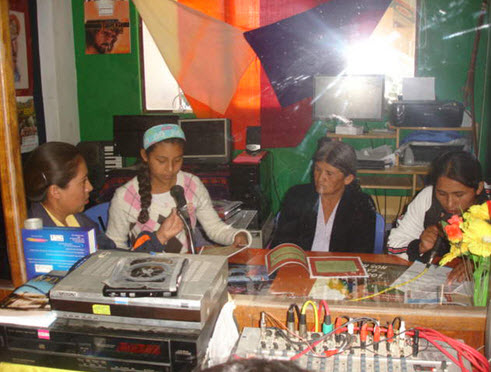
For example, an intergenerational group of four Bolivian Quechua-speaking women and girls used community radio for 21 sessions to spark debate and reflection on topics linked to politics and women’s and indigenous rights. They broadcast through the Ecológica community radio station in the town of Cliza, Cochabamab, Bolivia. The group leader Tifonia Tordoya, her daughters, and granddaughter broadcast "Wakichikuy wasiyuj allin kawsayta tarinapaj" ("Get ready to live well", in Quechua). The programme was a result of her concern about the participation of women in productive activities and decision-making in her village and was catalysed by a programme on "Political culture and cultural diversity: Empowering citizens in Quechua-speaking populations of Peru and Bolivia", carried out by the non-governmental organisation (NGO) Ciudadanía: Comunidad de Estudios Sociales y Acción Pública (Citizenship: Community of Social Studies and Public Action).
This programme is aimed to foster an intercultural political dialogue and strengthen democratic values among women, while tapping into the knowledge of indigenous women. For three years, women leaders of 20 rural community organisations from Quechua-speaking areas in the highlands valleys of Cochabamba worked to build their own definitions and concepts of key rights and issues, drawing on their own life experiences. They chose 19 elements, including democracy, legitimacy, autonomy, rights, gender violence, exclusion, discrimination, transparency, corruption, and justice. In order to bring the discussion to their communities through radio programmes, plays and short "spots", as well as workshops, they needed to create some local language words for the concepts they were discussing. For example, they decided to call gender “qhari-warmi” (man-woman), because a key principle in the Quechua culture is the complementarity and parity of opposites. And their definition of gender is: “Men and women have the same rights, capacities and way of life, choosing and being chosen, helping each other in work and in life.”
IPS (Inter Press Service) News website and ERBOL website, April 22 2013. Image credit: Jenny Cartagena/IPS
- Log in to post comments