










































Women's Empowerment Mainstreaming And Networking (WEMAN)
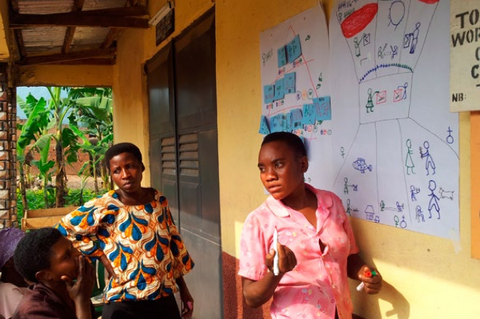
Women’s Empowerment Mainstreaming And Networking (WEMAN) is an initiative which focuses on gender mainstreaming in rural development with the objective to contribute to food and income security, sustainable livelihoods, and gender equality in sub-Saharan Africa and Asia. Implemented by Oxfam Novib, the project works with local civil society, governments, businesses as well as United Nations agencies and other donors to support them to put gender frameworks into practice in their programmes. This is mainly achieved by integrating the Gender Action Learning System (GALS) - a community-led empowerment methodology - into financial services, farmer training, business development services, and market linkages. Using visual diagrammes, this methodology enables women and men in marginalised rural communities to imagine the futures they want and through reflection and sharing of ideas and experiences take action against societal norms that drive gender inequality. The ultimate vision of the project is “[A] world where women and men are able to realise their full potential as economic, social and political actors, free from all gender discrimination, for empowerment of themselves, their families, their communities and global humankind.” The project runs from 2008–2020 and, so far, over 100,000 women and men and more than 70 organisations have been directly involved in WEMAN in countries such as Uganda, Rwanda, Nigeria, Sudan, Peru, Colombia, Pakistan, and Bangladesh.
As the name suggests the Womens' Empowerment Mainstreaming And Networking (WEMAN) project works throughout three different strategies:
Strategy 1 - Women’s empowerment - Community-Led Gender Action Learning
GALS is based on a generic community-led planning methodology called Participatory Action Learning System (PALS). In PALS gender has always been mainstreamed. In GALS the main focus is active promotion of a community-led gender justice movement. GALS was developed under the WEMAN programme with Linda Mayoux and local partner civil society partners in Uganda, Sudan, Peru, and India. The methodology consists of:
- A set of principles related to gender justice, participation, and leadership;
- A series of visual diagramming tools that are used for visioning, analysis, change planning and tracking by individuals, households, stakeholder groups, or in multi-stakeholder settings;
- Peer learning mechanisms and structures for ongoing action learning in communities; and
- Mechanisms to sustainably integrate GALS in organisations or interventions such as financial services, business development services, and agricultural extension.
GALS is typically integrated in economic interventions such as microfinance; value chain development; business development services; agricultural extension and other livelihood support. Using the tools described above, GALS is used for:
- Individual life and livelihood planning - women and men, including those who cannot read and write, keep diaries to develop their visions for change in gender relations and improved livelihoods, to plan how they can move towards their goals, and gain more control over their lives.
- Collective action and gender advocacy for change - When a critical mass of women and men are actively using GALS, it can be used for advocacy and movement building. Individual plans are brought together for a common purpose. With more control of their own development process, communities collectively negotiate for better wages or prices for their products, develop win-win strategies with powerful actors, build assets and position themselves as attractive partners for buyers and investment funds.
- Institutional awareness-raising and changing power relationships with service providers, private sector stakeholders, and government bodies - social change movements are catalysed by poor people who have themselves undergone a change process. With collective agenda’s they negotiate better terms and conditions for trading, decent work and more relevant services. Attitudes in public and private institutions are challenged, giving poor women a respected voice in decision making.
For more information on GALS see the following publications:
- Gender Action Learning System - Practical Guide for Transforming Gender and Unequal Power Relations in Value Chains [2014]
- Imagining the Future - The GALS methodology for livelihoods improvement and gender justice
- Rocky Road to diamond dreams - GALS Phase 1 Visioning and Catalysing a Gender Justice Movement Implementation Manual, V1.0 - March 2014.
Strategy 2 - Mainstreaming Gender for Better Outreach and impact
At organisational levels, gender and participatory principles and tools are integrated into projects, services or other operations to make their outreach more inclusive and effective. The project works with the people who deal with the women and men participating in GALS in their business lives – for example, sellers of seeds and fertilizer, microfinance institutions (MFIs), civil society organizations (CSOs), and buyers of their products – to help them develop relationships which are fair and sustainable and respect gender equality.
Strategy 3 - Networking - Global Learning Network and Advocacy Movement
The project encourage people in local communities and the institutions that influence them to learn from each other and join together to advocate for policy changes at local, regional, and global levels. All actors involved in WEMAN participate in a forum to document and exchange experiences, learn from each other to strengthen activities and come together for regional and global advocacy. This aims to create evidence of effectiveness of community-led approaches in economic development, and influence policy, programme design and implementation.
Gender, Agriculture, Rural Development
Rationale for the project:
“In Sub-Saharan Africa and South/South-East Asia, millions of rural households subsist by producing products such as grains, pulses, textiles, coffee, cocoa, and shrimps. Typically these are bought by middle traders and sold into the global food market.
Many organizations are working to help rural households produce more and higher-quality crops, which can command better prices, and to manage their money more effectively through access to loans, savings and insurance products. Yet often projects in agricultural value chains, local economic development, financial and extension services focus narrowly on technologies and/or crops. They don’t explicitly tackle the social norms or customary and legal frameworks which underlie power imbalances between ethnic groups, women and men; urban and rural; or literate and non-literate people. These power imbalances mean men often make little contribution to household welfare, while women have little say in household decisions.
Globally three quarters of working age men are in the labour force compared to half of working age women. Among those who are employed, women constitute nearly two thirds of ‘contributing family workers’, who work in family businesses without any direct pay. Women continue to be denied equal pay for work of equal value and are less likely than men to receive a pension, which translates into large income inequalities throughout their lives. Yet in all regions women work more than men: on average they do almost two and a half times as much unpaid care and domestic work as men, and if paid and unpaid work are combined, women in almost all countries work longer hours than men each day (UN Women, 2015). Other key gender inequalities are related to property ownership, domestic violence, mobility and decision making. Overcoming these inequalities provides pathways out of poverty and is essential for sustainable inclusive growth.”
Project outcomes:
Some of the typical ways that WEMAN changes the lives of poor and marginalised rural communities include:
- Women having the right to own agricultural land and having secure access to the land. Previously, they could be chased away by in-laws or local chiefs in case of divorce due to family conflicts or death of male relatives.
- Households now have more savings, giving them greater resilience against unexpected expenses. Previously, household income was often wasted on alcohol abuse and household products were frequently sold below market value to realize an urgent need for cash.
- Men now help with tasks such as fetching water and firewood and looking after children. Previously, these burdens were carried only by women.
- Households now get higher incomes and productivity by collectively investing in storage and processing equipment, forming groups to negotiate better prices for seeds and other inputs, and selling their products collectively in bulk. Thus positioning themselves as attractive partners for buyers and investment funds. Previously, people distrusted each other and operated individually.
Oxfam Novib website and WEMAN Brochure on March 24 2017.
- Log in to post comments