










































Community of Practitioners on Accountability and Social Action in Health (COPASAH)
Vision: "Communities are actively engaged in promoting accountability and transforming health systems towards the realization of social justice."
This network seeks to nurture, strengthen, and promote collective knowledge, skills, and capacity of community-oriented organisations and health activists - primarily from Africa, Asia, and Latin America - working in the field of accountability and social action in health. The aim is to promote active citizenship to make health systems responsive, equitable, and people-centred. COPASAH believes that in order to make this vision a reality, community monitoring for accountability in health must:
- enable communities facing inequities to assert their rights and to participate in concrete actions to bring about changes in health services and equitable distribution of resources;
- give voice to people's perspectives;
- be an empowering process where actors related to the health system are encouraged to address power imbalances that affect people's health; and
- be linked to an action or advocacy plan which aims to influence or change health policies and programmes.
Using digital and face-to-face communication, COPASAH undertakes the following key activities, through its network: (i) capacity building; (ii) technical assistance; (iii) facilitated learning exposure visits; and (iv) documentation and audio-visual support.
First, the COPASAH website and Facebook page are part of an effort to: nurture a community of practitioners via cross-pollination of ideas, experiences, and resources; facilitate systematic exchange of knowledge and practice; create opportunities for interaction between practitioners; inform and influence others; build strategic alliances; and foster collaborative action.
Second, COPASAH offers regional training programmes in Asia, Latin America, and east and southern Africa. For example, COPASAH is organising a 5-day training workshop in Delhi, India, in September 2013. The workshop's purpose is to build the capacity of civil society organisations (CSOs) on accountability and transparency, with a view to strengthening the field of community monitoring for accountability in health in South Asia. This training is for the south-Asian region and pertains specifically to participants in India. Further, COPASAH will provide small grants to selected organisations to support the incorporation of the newly acquired skills. In addition, COPASAH participates in events such as the Second Global Symposium on Health Systems Research, held in Beijing, China, from October 31 to November 6 2012. The Symposium brought together researchers, policymakers, funders, implementers, civil society, media representatives, and other stakeholders to share new evidence, identify opportunities and gaps, and build understanding of health systems research (HSR). Drawing from existing experience from its member organisations working in the area of community monitoring for accountability in health, COPASAH aimed to: raise the profile of and facilitate cross-region exchange, networking, and review of community-based evidence, knowledge, and action in building universal health systems; explore the role of community monitoring approaches in promoting social accountability; and call for integration of such approaches in follow-up work to support health systems research after the Symposium. More information is available on the COPASAH website here.
Health, Rights
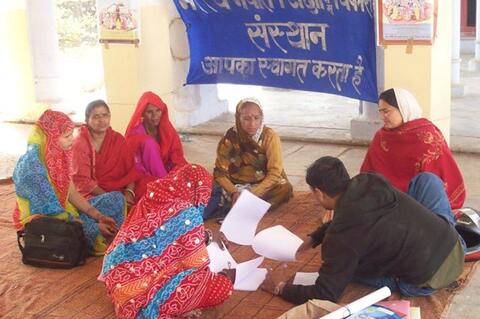
Email from Brett Davidson to The Communication Initiative on July 16 2013; and COPASAH website, July 18 2013. Image caption/credit: Community Monitoring in Assam and Rajasthan, India - courtesy of Centre for Health and Social Justice (CHSJ)
- Log in to post comments