










































Community Video for Social Change: A Toolkit
Image
SummaryText
This toolkit, published by the American Refugee Committee and Communication for Change, is a guide to planning and implementing participatory video activities in conflict-affected settings, with a focus on gender-based violence prevention and response, harmful practices, HIV/AIDS, and related health issues.
The toolkit comprises two documents. The first outlines practices and approaches related to using community video for social change in conflict-affected development and humanitarian settings. It also outlines steps for planning and designing a community video project, as well as implementation, ongoing support, and ways of integrating community video activities into broader work within an organisation or programme. The toolkit provides recommendations for monitoring and evaluation, and suggests opportunities for sharing experiences.
The second document is a manual titled "A Practical Guide to Community Video Training." This guide provides detailed session descriptions, exercises, and support materials for a two-week training workshop integrating thematic content with video production, team-building, and interpersonal communication skills.
The guide is designed primarily as a facilitation tool; however, it can also serve as a resource for communication personnel, programme managers, and humanitarian aid agency and non-governmental organisation staff who wish to strengthen health and social development programmes through participatory video. It is also intended as a resource for health advocates, media activists, social researchers, students, and others seeking in-depth information on participatory communication and community-based social change.
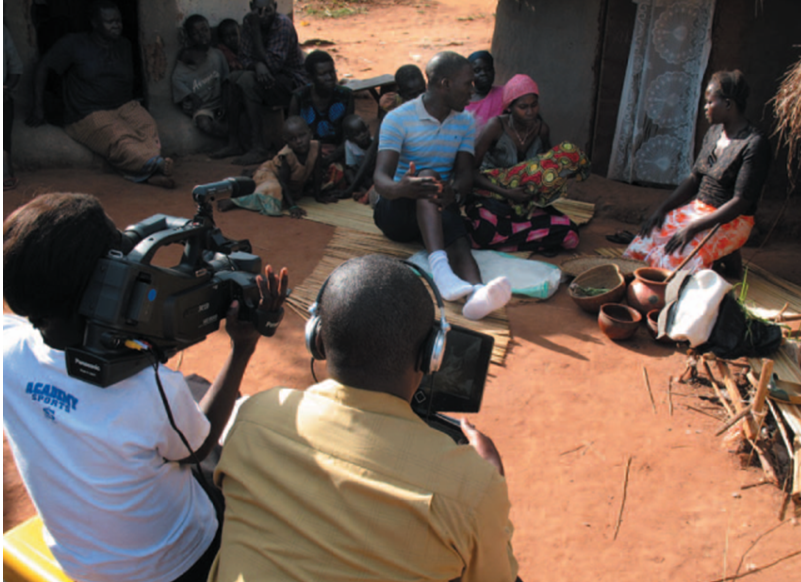
The toolkit was produced based on the experiences of the "Through Our Eyes" community video project in Liberia, Uganda, Sudan, Thailand, and Rwanda. Implemented by the American Refugee Committee (ARC) and its technical partner, Communication for Change (C4C), the project has been primarily supported by the United States Agency for International Development (USAID) since 2008. Throughout the toolkit, relevant examples from the Through Our Eyes experience and other participatory communication programmes are integrated.
The toolkit comprises two documents. The first outlines practices and approaches related to using community video for social change in conflict-affected development and humanitarian settings. It also outlines steps for planning and designing a community video project, as well as implementation, ongoing support, and ways of integrating community video activities into broader work within an organisation or programme. The toolkit provides recommendations for monitoring and evaluation, and suggests opportunities for sharing experiences.
The second document is a manual titled "A Practical Guide to Community Video Training." This guide provides detailed session descriptions, exercises, and support materials for a two-week training workshop integrating thematic content with video production, team-building, and interpersonal communication skills.
The guide is designed primarily as a facilitation tool; however, it can also serve as a resource for communication personnel, programme managers, and humanitarian aid agency and non-governmental organisation staff who wish to strengthen health and social development programmes through participatory video. It is also intended as a resource for health advocates, media activists, social researchers, students, and others seeking in-depth information on participatory communication and community-based social change.
The toolkit was produced based on the experiences of the "Through Our Eyes" community video project in Liberia, Uganda, Sudan, Thailand, and Rwanda. Implemented by the American Refugee Committee (ARC) and its technical partner, Communication for Change (C4C), the project has been primarily supported by the United States Agency for International Development (USAID) since 2008. Throughout the toolkit, relevant examples from the Through Our Eyes experience and other participatory communication programmes are integrated.
Publication Date
Languages
English
Source
Email from Lauren Goodsmith to Soul Beat Africa on September 20 2011 and American Refugee Committee website on October 3 2011.
- Log in to post comments