










































Concept Paper: International Gender Justice Dialogue

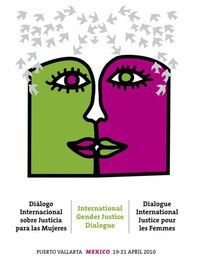
This 4-page paper was created in support of the International Gender Justice Dialogue, a convening held by Women's Initiatives for Gender Justice and the Nobel Women's Initiative (NWI) from April 19-21 2010 in Puerto Vallarta, Mexico. The Dialogue brought together a group of 80-90 gender experts, feminist legal theorists, peace mediators, legal practitioners, jurists, women's rights advocates, policymakers, members of the media, and activists to develop a strategic, shared agenda for advancing gender justice around the globe.
The concept paper begins by providing context for the gathering. From May 31 to June 11 2010 in Kampala, Uganda, the Assembly of States Parties will hold the 10-year Review Conference on the Rome Statute and the International Criminal Court (ICC). Hosted by the Government of Uganda, this conference is expected to draw 110 States Parties to the Rome Statute and is open to all United Nations (UN) members. Organisers of the Dialogue thus felt that this would be an opportune moment to reflect on the progress and work of the ICC, the possibilities embodied in the Rome Statute for the accountability of conflict-related crimes, and the responsibilities of the UN - in particular, the UN Security Council - for the deterrence and resolution of armed conflicts, women's global citizenship, and gender-inclusive international justice.
Subsequent sections examine the background for the Dialogue, the political context, and the goal of the convening. The core idea is that, by developing a shared set of priorities for advancing gender justice globally, participants in the Dialogue are seeking to increase the efficacy of all their advocacy efforts. The strategies were to be developed through:
- critically reflecting on the successes and developments to date in the work of the ICC, regional human rights courts, and Security Council Resolutions to address gender-based violence - particularly in armed conflicts - and ensure to accountability for such crimes;
- identifying priorities and strategies for impacting on peace processes, including the appointment of mediators, the setting of their mandates, and ensuring the inclusion of women and gender issues within negotiations and subsequent peace agreements;
- identifying the pressing issues in the field of international justice and peace regarding prevention and prosecution of violence against women;
- assessing the deterrent capabilities of the ICC and the UN Security Council in relation to the deterrence of gender-based crimes as acts of genocide, war crimes, and crimes against humanity;
- contributing to the discourse on violence against women, especially in conflict and post-conflict situations;
- examining what communication strategies have been most effective in promoting the use of international justice mechanisms to address violence against women; and
- taking stock of key future opportunities for amplifying women's voices in advancing gender justice.
The questions around which the agenda was organised are outlined next. For instance: "How can we most effectively communicate our key priorities to advance gender justice? What are the examples that help the public understand how international justice mechanisms helps prevent or address gender-based crimes? Are there 'key messages' that we can all promote as we try to move forward with a more cohesive gender justice strategy?"
In concluding, the paper notes that, "[b]y creating a space where advocates from around the world and a diversity of disciplines can meet and talk in person, the Dialogue creates an opportunity to advance thinking and collaboration on gender justice issues that only in-person dialogue can foster. Furthermore, sharing information and insights in order to develop strategies will support better and more effective use of advocacy and communications resources. A final communiqué (in English and Spanish) will be distributed to regional and international media and audiovisual documentation will be disseminated through the websites and using social media tools....Furthermore, the strategies that are developed in the Dialogue will be disseminated broadly throughout civil society and will help shape the messages to decision makers."
Posting to the Women's United Nations Report Network (WUNRN) listserve, April 14 2010; and International Gender Justice Dialogue website, May 5 2010.

- Log in to post comments