










































The Empower Project: Fostering Alliances for Action Against Gender Based Violence in Benin
CARE International
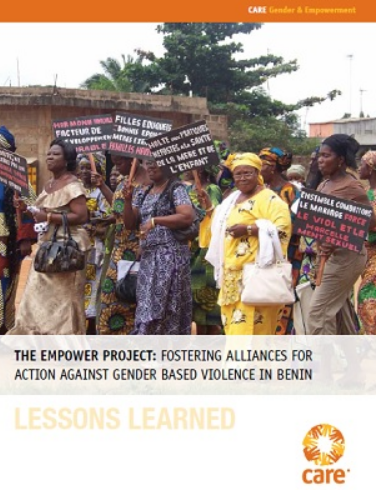
This 8-page case study highlights the experiences and lessons learned from Care International's EMPOWER (Enabling Mobilization and Policy Implementation for Women’s Rights) Project in Benin, which was designed to galvanise a national response to gender-based violence (GBV) by strengthening support services for survivors and improving policies and laws on GBV and women's rights more broadly. Funded by the United States Agency for International Development (USAID), the project was run from 2007 to 2012. According to the case study, the contribution of CARE and its partners in shaping the national response to GBV was rooted in their ability to convene a vast network of players as change agents, advocates, pressure groups, survivors, service providers, and decision makers, to reduce GBV and assist survivors.
The EMPOWER project was designed to respond to GBV challenges through a comprehensive approach involving strategies aimed at 1) communications for social change, 2) advocacy for policy reform, and 3) capacity-building to strengthen referral systems and delivery of services to survivors of violence. The EMPOWER project worked to create a national platform for action against GBV by convening and building partnerships among civil society and public sector stakeholders across the country's twelve regions. The first step taken by CARE Benin in planning the initiative was to compile a nation-wide inventory of potential partners and stakeholders that could serve complementary roles and create synergy in the initiative. This included institutions involved in policy implementation and service provision, hailing from the health, justice and security sectors, traditional and religious leaders' authorities at national and community levels, and the media.
The strategy focused on mass mobilisation and sensitisation to increase awareness and change attitudes on GBV and to expand the base of support for anti-GBV legislation among key constituencies at grassroots levels. EMPOWER partners worked with government agencies and lawmakers to support the drafting of new anti-GBV legislation. After the introduction of the bill, EMPOWER's partners actively lobbied lawmakers and parliamentary groups to ensure the passing of the bill. The partners worked with influential allies and interlocutors, including former parliamentarians and the media, to influence lawmakers. They organised working sessions with representatives from ministries, the judiciary and the police, and participated in multi-stakeholder forums involving development agencies such as UNICEF, UNFPA and USAID. At departmental level, EMPOWER organised regular forums, workshops and advocacy events aimed to engage decision makers in action to address GBV, based on each department’s local realities and needs.
According to the case study, efforts to address GBV in Benin are now anchored in a more enabling environment due to the passing of the new anti-GBV law, the release of the 2010-2014 National Action Plan for combating violence against women, a multisectoral referral system for survivors that arose out of the Synergy Group innovation, and increased social visibility and awareness of GBV among the general population as a result of community level sensitisation efforts. However, the case study noted that much remains to be done to ensure enforcement of the legislation, including raising awareness of the law among responsible actors and the general public, strengthening referral systems and the institutional capacity of service providers, and addressing socio-cultural obstacles to survivors’ access to assistance. EMPOWER's experience also highlights the role of resources and strong partnerships needed to promote action. The case study concludes that the project's effectiveness was dependent on a solid understanding of the landscape of players who could be marshalled towards an effective anti-GBV response.
The case study makes the following recommendations for government as well as donors:
- Greater attention and support should be provided to interventions that are designed to convene and coordinate stakeholders involved in GBV prevention and response efforts across sectors, and bring together government institutions and civil society. The convenor or coordinator role should be an integral part of GBV institution building efforts, and should be budgeted for. Non-governmental organisations can effectively play the role of convenor, when provided with adequate support and space by government and partners.
- Funding for programmes aimed at GBV prevention and response should include a focus on advocacy and social mobilisation. Support should be provided for interventions that are built on strong networks, supported by a range of local institutions and actors, and that are able to leverage resources and support from key stakeholders, including governments and NGOs.
- Increased community mobilisation and advocacy is bound to generate demand for services as a result of increased awareness and reporting. As such, governments and donors need to ensure a proportionate focus on building support services for GBV survivors to ensure that the system can meet increased demand. This is particularly so in the early phase of developing an anti-GBV response in a low-resource setting.
Care International website on October 15 2013.
- Log in to post comments