










































EMPowerment for ADvocacy: The EMPAD Policy Framework for National Advocacy by and with Key Populations
Image
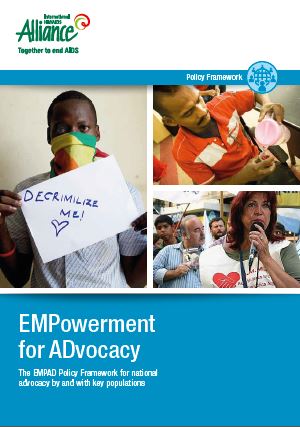
SummaryText
Published by the AIDS Alliance, "this tool is intended to support national-level advocacy as an element of HIV programmes designed with and for key populations".
As stated in the publication, in many settings, key population representatives do not have a voice in HIV policy processes and must lobby persistently to be included. In response to this situation, the Alliance developed the EMPAD (Empowerment for Advocacy) Policy Framework. The publication explains how civil society organisations and networks can use the EMPAD Policy Framework for:
Following an introduction, the publication is divided into two parts: Part 1 - The EMPAD Policy Framework: This section provides an overview of the elements of the EMPAD Policy Framework, with brief case studies. The section outlines the Framework's "theory of change", which is based on the following five high-level strategies:
According to the publication, "while EMPAD was formulated with national-level advocacy efforts in mind, its principles can be adapted easily to the regional and global levels."
As stated in the publication, in many settings, key population representatives do not have a voice in HIV policy processes and must lobby persistently to be included. In response to this situation, the Alliance developed the EMPAD (Empowerment for Advocacy) Policy Framework. The publication explains how civil society organisations and networks can use the EMPAD Policy Framework for:
- designing new advocacy and campaign programmes;
- developing advocacy-related funding proposals; and
- communicating advocacy work around key populations.
Following an introduction, the publication is divided into two parts: Part 1 - The EMPAD Policy Framework: This section provides an overview of the elements of the EMPAD Policy Framework, with brief case studies. The section outlines the Framework's "theory of change", which is based on the following five high-level strategies:
- Strengthen alliances and advocate in support of key populations and a shift in social perceptions;
- Increase the capacity of organisations of key populations to carry out advocacy;
- Engage in national policy processes;
- Link grassroots, national, regional, and global advocacy; and
- Promote knowledge sharing among advocacy programmes and decision-makers.
- Case study 1 - Improving the response to MSM [men who have sex with men] in Senegal
- Case study 2 - Addressing HIV in Latin America by advancing the rights of transgender people
- Case study 3 - A regional platform for training national stakeholders on rights-based programming.
According to the publication, "while EMPAD was formulated with national-level advocacy efforts in mind, its principles can be adapted easily to the regional and global levels."
Languages
English
Number of Pages
32
Source
AIDS Alliance website on July 28 2014.
- Log in to post comments