










































Equator Dialogues
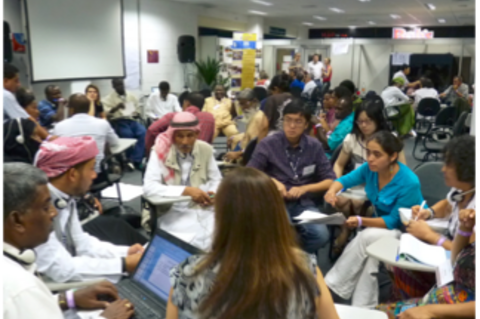
The Equator Dialogues is an element of the Equator Initiative, a partnership launched in 2002 that brings together the United Nations, civil society, business, governments, and communities around the world in an effort to help build the capacity and raise the profile of grassroots efforts to reduce poverty through the conservation and sustainable use of natural resources.
This programme uses community-based online spaces and in-person events in an effort to provide an advocacy and learning platform for local leaders and grassroots initiatives seeking to take local steps to help achieve the MDGs. The central purpose of these exchanges is to break down barriers to community participation in political processes and policy formulation. These exchanges draw on dialogue in an effort to:
- invigorate global conferences and regional workshops with local voices, knowledge, and perspectives
- celebrate "local level best practice" in poverty reduction and biodiversity conservation
- shift the policy environment and scale up grassroots work by facilitating community and local level access to policy makers
- stimulate knowledge sharing and exchange at the local level
- train local leaders and promote advocacy initiatives.
Events have been held in communities around the world that have explored the role of the community in protecting the environment and raising incomes. These core meetings are designed to provide a backdrop for the additional advocacy and outreach events that the Equator Initiative organises each year. Information and communication technologies (ICTs) are key here for sharing information about these exchanges; each special dialogue event has been documented on its own website; click here for more information, and to access specific examples of these web-based offshoots.
One way to understand this process is through a specific example - a dialogue titled "The Community Commons: A Dialogue on Local Approaches to the MDGs" that took place in June 2005 at one of the partner's institutions (Fordham University). As detailed on the Equator Initiative website, the Community Commons involves the creation of a physical dialogue space to facilitate group discussions, presentations, cultural events, and interaction with global leaders and the media. The goal of this exchange was to stimulate and sustain a forum for community voices and perspectives to be incorporated into the 5-year Millennium Review Summit process, particularly through participation in the preparatory Civil Society Hearings, by drawing on the experience and insights of community representatives from around the globe. One element of this process is capacity building - to be achieved through an action plan that works to support broad-based learning between communities and through recommendations on how policy makers could develop their own capacity to support locally-driven community development innovation. The outcomes from this forum and others that are part of Equator Dialogues documented in the form of Community Declarations - consensus documents, written by all participants, that are designed to capture the essence of the deliberations and perspectives of participating communities with respect to fundamental questions of development and community engagement. Click here to access these documents.
To cite another example, in June 2012, the Community Aldeia brought together winners of the Equator Prize 2012 from 25 countries, other leaders in community-based sustainable development, and the Equator Initiative partnership in a ten-day dialogue held in parallel to the United Nations Conference on Sustainable Development (Rio+20). A week into the Community Aldeia, Equator Prize winners split into self-chosen thematic working groups to reflect on lessons learned over the course of the dialogue to date, and to discuss proposals for actions to collectively strengthen their work going forward. Groups focusing on medicinal plants, water access and public policy, food security and women's empowerment, and biodiversity conservation emphasised the importance of developing networks for sharing experiences between prize winners and like-minded local communities, sustaining the relationships forged during the Aldeia.
Biodiversity, Environment, Sustainable Development, Poverty.
United Nations Development Programme (UNDP), Fordham University, the government of Canada, Conservation International, The German Federal Ministry for Economic Cooperation and Development (BMZ), International Development Research Centre (IDRC), IUCN - The World Conservation Union, The Nature Conservancy, Television Trust for the Environment (TVE), and the United Nations Foundation.
Equator Dialogues page on the Equator Initiative website, August 17 2005; email from the Equator Initiative to The Communication Initiative on July 5 2012; and Community Aldeia website, July 6 2012.
- Log in to post comments