










































Faith, Empowerment, Church and Community Mobilisation Advocacy: Insights from Tearfund's Partner in Uganda
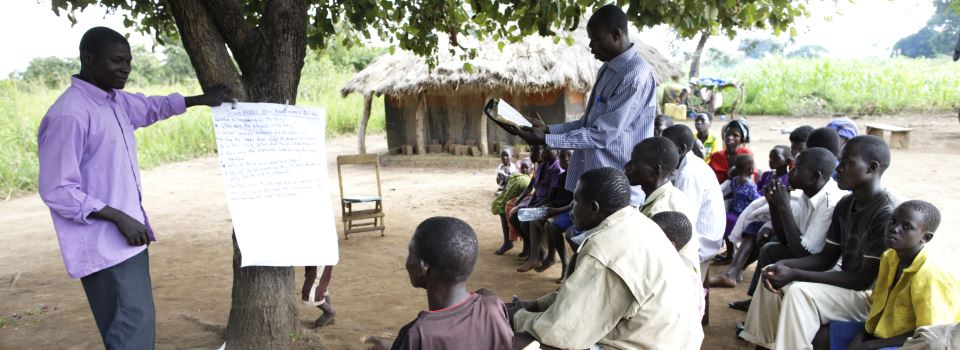
"CCM is powerful because it enables people to cast a vision collectively, to imagine solutions rather than problems. In some communities, there’s a history of people seeing themselves as victims and as recipients of aid. CCM tells you that you have the resources within you and within your community; that you are able to meet your development needs."
This practice paper discusses a pilot initiative undertaken by Tearfund, a Christian international relief and development agency, and its partner in Uganda, Pentecostal Assemblies of God (PAG), which sought to add an advocacy component to an existing community mobilisation process known as Church and Community Mobilisation (CCM). The purpose of the advocacy component was to mobilise communities to engage with local government in order to improve service delivery.
The practice paper discusses some of the findings of research on the pilot project, which set out to examine the role of local churches, CCM, and CCM advocacy in fostering transparency, citizen empowerment, inclusion, and government responsiveness. Tearfund also wanted to understand how best to scale up its CCM advocacy work in Uganda and beyond. The research was funded and the paper published by the Making All Voices Count initiative, a citizen engagement and accountable governance programme that seeks to build an evidence base on: what works in technology for voice, transparency, and accountability; how it works; and why.
The practice paper explains the process of CCM, which has formed part of Tearfund’s global community development work for more than 15 years. “The aim of CCM is to give vision to churches to mobilise communities and individuals to be able to achieve a ‘holistic transformation’ in which people flourish materially, psychologically and spiritually. CCM is sometimes referred to by the Swahili term Umoja, which means ‘togetherness’. CCM draws on an asset-based community development (ABCD) approach. Instead of looking to outsiders for solutions to social, economic, development and infrastructure problems, ABCD encourages a community to build an inventory of the human, financial, social, physical and natural assets of individuals, households and the community as a whole. ABCD tries to move away from understanding a community as a ‘list of problems and needs’ and this thinking underpins CCM. CCM, developed by Francis Njoroge in partnership with Tearfund, is directly derived from Participatory Rural Appraisal, which sought to use Freirean methods to involve marginalised people in community development. Trained CCM facilitators encourage reflection on passages of the Bible that relate to faith and development, social justice and servant leadership, enabling participants to critically reflect and act to better understand their social reality – what Freire calls the “conscientisation process”. CCM utilises the unique position of local churches to bring about mindset change and empowerment, and the local church creates a safe space for this empowerment and new thinking through the existing meaningful relationships in the community [Footnotes removed throughout]."
Tearfund recognised that communities cannot solve all the issues that they identify on their own, and therefore decided to pilot the incorporation of advocacy into the CCM process. Tearfund provided PAG with advocacy training, and PAG then trained, coached, and accompanied citizens to enable them to articulate their needs and rights, to access resources and services from local government, and to hold government officials to account. PAG also trained CCM facilitators on citizen rights, government responsibilities, and the local government planning and budget cycle. These facilitators then trained members of various communities, who were encouraged to form advocacy committees, adopt strategic approaches to local-level advocacy, and regularly review the success of their strategies.
Tearfund believed that the CCM advocacy pilot demonstrated promise, with particularly high levels of improvement in service delivery, and therefore wanted to conduct research to learn from and strengthen the CCM advocacy programme in Uganda. The practice paper describes the research process which, in brief, studied 18 PAG communities in the Teso region of Uganda. Communities fell into one of five categories: (1) no CCM training, (2) CCM training, (3) CCM training with incomplete advocacy training, (4) CCM advocacy training without implementation, and (5) full CCM advocacy training and implementation. Tearfund then followed a multi-stage research, learning, review, and dissemination process that included two rounds of qualitative field research, workshops, and webinars.
Using a conversational format with the research team, the practice paper discusses Tearfund’s findings and how CCM and CCM advocacy works. The discussion highlights:
- the roots of CCM and CCM advocacy
- the culture of learning and sharing at Tearfund and how this shaped the research design
- the role that CCM advocacy plays in changing individuals’ perceptions of themselves and their communities
- the ambition to embed inclusiveness in CCM advocacy
- how, through CCM advocacy training, citizens changed the way they engaged with government officials, which in turn affected how decision-makers saw and engaged with them
- the challenge of decentralisation, with citizens and government officials at the lower tiers struggling to access and understand information about national government plans, budgets, and policies
- how PAG, and the church more generally, is trusted and well-connected in Uganda, and that these social relationships and networks need to be utilised more – particularly at national level – to help improve service delivery, governance, and transparency and accountability across the country.
The practice papers ends with the following key recommendations for the future of CCM advocacy:
- Advocacy training should be provided alongside CCM, and proactive steps should be taken to include the most marginalised people.
- Partners should encourage churches and communities to review and restart CCM and CCM advocacy periodically.
- Facilitators should involve village leaders, parish council staff, and local government officers in CCM advocacy training.
- Partners and facilitators should provide translated and simplified policy documents.
- There should be more emphasis on monitoring government performance and budgets in advocacy training.
- Local churches should provide a model of transparency to the community, and actively build relationships with the different tiers of government.
- Partners should organise learning visits between advocacy committees and facilitate coordination among local communities working on similar advocacy issues.
- Partners should use networks to promote local advocacy and connect to national and international campaigns.
Making All Voices Count website on May 17 2017.
- Log in to post comments