










































Get Moving! Transforming Individuals and Organizations
Raising Voices
"Stated simply, the core drivers of VAW are unequal power between women and men in our societies and the patriarchal systems and norms that uphold this power imbalance."
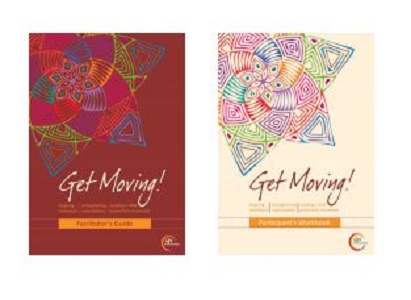
From the GBV Prevention Network (preventgbvafrica.org) of Raising Voices, this learning paper offers research-based reflection on six years of experience in the Get Moving! programme on violence against women (VAW). The feminist perspective on VAW, quoted above, results in the key component of developing technical capacity to do the political work of transforming power structures at multiple levels (e.g., individual, family, community, and the wider society) to advance VAW prevention programming, including through using the Get Moving! programme.
The Get Moving! methodology helps organisations move through ten topics of personal and organisational exploration "using a range of creative activities, such as private journaling, structured exercises, group reflections, role plays and supplemental reading. The three overarching objectives are as follows:
• To inspire individuals to critically reflect on personal values and identities and connect more deeply with key VAW concepts.
• To strengthen organizations by identifying opportunities to enhance organizational culture and integrity by engaging in values-driven work.
• To contribute to a cohesive movement to prevent violence against women by fostering a shared analysis of the core drivers of VAW and acknowledging the positive power of working in solidarity."
Research on participant experience was done using informant interviews, written evaluations by participants and facilitators, a group discussion, and participant remarks from a workshop. Emergent themes were collected through thematic coding and synthesised into the following results:
- " A feminist connection to VAW work grows from first looking inwards at oneself.
- Individually living the values of VAW work can shift organizational culture.
- A reframing of activism and professional solidarity helps to build a movement.
- Personalizing VAW work takes courage, time and resources that can feel beyond one’s capacity."
The following key practices were identified for moving from research to action:
• "Make a commitment to looking within before looking out....Effective VAW prevention and response requires an organization to invest in and set aside time for staff processes that foster personal reflection of one’s own values about power, equality, non-discrimination and agency - and how these values are applied at personal and professional levels."
• "Prioritize regular, creative internal staff processes." Treat internal learning and reflection "as an essential foundation for quality programming. Breaking down core VAW concepts repeatedly and through a range of creative and participatory formats - including readings, exercises, group work, private reflections and journaling - can ensure meaningful staff development and organizational growth."
• "Welcome and accept tensions and challenges as growth opportunities....Change requires an openness to new ideas and perspectives and accepting some unease in the process. Leaders can welcome rather than avoid such tensions, choosing to see these moments as opportunities. This role modeling can foster more openness among staff and the safety needed for honest conversations to emerge."
• "Engage a strong facilitator for key organizational processes: The importance of strong facilitation by a staff member who is skilled, respected and perceived as fair cannot be overstated. For example, the facilitator’s ability to create a safe space where divergent views can be freely expressed provides the foundation for authentic personal reflection and organizational change...."
• Use and adapt tools for staff development: It is important to seek new tools for staff development that allow for authentic transformation. Whether using Get Moving! or another open source tool, it is critical for organizations to reflect on how the process can best be integrated within their own organizational context....creating space to articulate a clear vision and process at the outset is an essential step."
• "Expect profound changes to take time....adopting a long-term view and remaining patient can go a long way toward consistent implementation."
GBV Prevention Network website, July 27 2018.
- Log in to post comments