










































Intimacy Without Risk: Community Dialogues to Reduce Concurrency in Lesotho
USAID
This 12-page case study looks at the Intimacy Without Risk project in Lesotho, which used community dialogues and mass media to engage adult community members and couples in dialogue to raise awareness of multiple concurrent partnerships, and address key factors that perpetuate these relationships, such as alcohol, migration, intergenerational and gender inequality, and pervasive social norms of concurrency, and to encourage positive and responsible sexual behaviour. The case study looks at the strategies used and highlights some of the results of an evaluation, drawing out lessons learned and offering several recommendations for others exploring the use of this community-based intervention.
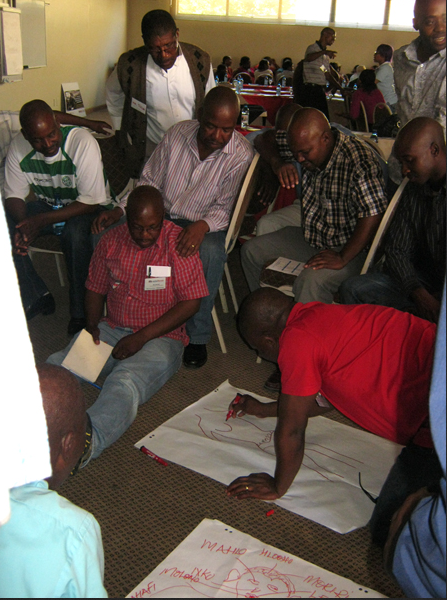
C-Change worked in partnership with the National AIDS Commission (NAC), the Ministry of Health and Social Welfare (MoHSW) in Lesotho, and a local non-governmental organisation (NGO), Phela Health and Development Communications (Phela) to implement the Relationships: Intimacy Without Risk project. In the context of Lesotho, C-Change community dialogues were facilitator-led, informal, participatory groups that were provided with open space for group members to become comfortable with discussing sexual issues, identify the drivers of HIV within their wider social and cultural contexts, and address their own attitudes and behaviours toward the virus in order to make positive individual and collective decisions and plans to further disease reduction.
C-Change commissioned Health Sciences Research Council (HSRC) to conduct a qualitative evaluation of the community dialogues. A sample of 158 women and 107 men ages 18 and older from all districts where the dialogues took place participated in in-depth interview (IDI) and focus group discussion (FGD) methodologies to assess how the community dialogues had affected participants and the community as a whole.
The results showed that the perceived positive effects of the initiative included:
- improved sexual behaviour (reduction in concurrency practices, increased practice of protected sex, and reduction of transactional sex);
- more open communication about sex and other sensitive issues in communities and with sexual partners, spouses, children, parents, families, and peers;
- improved relationships with sexual partners, including strengthened emotional ties, trust, and commitment, improved sexual techniques and altered gender norms relating to women taking the initiative in sexual relationships;
- increased information dissemination and knowledge about HIV and AIDS;
- improved health-seeking behaviour, including increased uptake of HIV testing;
- increased acceptance of one's own HIV status; and
- increased sense of personal contribution and empowerment in the community.
The report identifies the following factors that worked well in the intervention:
- Partnerships with stakeholders: The community dialogue project was a collaborative effort. C-Change made concerted efforts to build relationships at national, district, and community levels. This occurred through participation in technical working groups to share programme progress, tools, successes, and lessons learned. During community dialogue trainings, organisations such as Population Services International (PSI) and Lesotho Planned Parenthood Association (LPPA) facilitated sessions on HIV and AIDS. Following the trainings, C-Change referred community groups to PSI and LPPA reproductive health services and condoms.
- Use of existing community groups: C-Change worked with existing community groups to engage community members and couples in the dialogues. These groups were recognised by local leadership and met on a regular basis around a specific objective prior to the C-Change programme. While there were challenges around compensation, scheduling, and outreach activities, this approach allowed for HIV prevention to be mainstreamed into ongoing community groups and contributed to sustainability.
- Integration of community mobilisation and mass media components: The C-Change programme used a multi-channeled SBCC intervention. The OneLove campaign worked to increase awareness of the risks related to concurrency among adults ages 18–50, which was linked with tools for groups to carry out community-level discussions. These two mutually supporting components of mass media and community mobilisation, effectively used different channels to communicate mutually reinforcing messages. The radio PSAs and talk shows provided community dialogue groups with additional topics for discussion within HIV prevention. This linkage between the community-based activities and the wider OneLove campaign, provided groups with catchy and well-recognised terms to converse with others about the programme.
- Support visits: While the dialogues were run by trained community members, providing ongoing technical assistance and monitoring was crucial. Phela staff working in the C-Change programme conducted regular support visits to the community groups. This was an opportunity for programme staff to collect data, and provide the group with additional materials.
Based on successes and challenges, the report makes several recommendations for future programming:
- More in-depth consultations with community councils and groups: Substantive consultation with local leadership should take place prior to selection and participation of community members in the training. This should include additional feedback and consensus about the most appropriate timing, duration, and frequency of community dialogues.
- More defined criteria for selecting CGFs and community groups: Lessons from Lesotho showed that groups that had the highest chance of completing the dialogue programme and outreach activities were groups that met frequently (i.e .soccer clubs, PLHWA support groups) rather than groups that met only periodically (i.e burial groups) or had members that were spread across a few villages. This information should inform the types of groups to recruit. In addition, in the selection of CGFs there is need for a certain level of literacy with the expectation that future CGFs will be trained in a curriculum, fill out monitoring forms, and facilitate discussions/games taken largely from a text-based manual.
- Expansion of the programme to institutions: To further integrate the intervention, it would be beneficial to expand/adapt the community dialogue programme to schools (students, teachers) criminal justice institutions (i.e.prison staff and inmates), and local businesses.
- Increased support to groups for outreach events: To allow the learnings of dialogue members to more effectively impact the larger community, more support should be made available for increased strategic cultural and community outreach activities such as dramas related to concurrency, HIV counseling and testing at local rallies, and sponsored community competitions among youth.
- Division of community groups by age and gender: Due to the sensitivity of topics around concurrency and the cultural context in many environments, dialogues within existing community groups should be separated by age and gender. Options around having these sub-groups come back together as a large group to summarise the discussion should be explored.
C-change website on June 6 2013.
Image credit: Phela
- Log in to post comments