










































Mobile Phone Networks Champion Social Change in the Third World
The Guardian
According to this article from The Guardian: "Money transfer, healthcare, farming and education are all areas now covered in the developing world by rapidly spreading mobile phone networks."
The author chooses the examples of a Vodaphone m-banking project expanding beyond the country of Kenya and a Nokia application through moving into India, Indonesia, and China as examples of mobile technology "becoming a workhorse to create social change in developing and rural communities where modern-day infrastructures are weak or non-existence....While some philanthropic organisations, non-government organisations (NGOs) and national governments are operating free initiatives in countries such as Kenya and China to help stamp out poverty and improve rural communities, the mobile phone players believe their services are sustainable simply because they need to succeed commercially. Their free-market strategy is to provide crucial, personalised information to millions of people - mostly those outside urban areas - and that the sheer volume of micro-payments will lead to profit and better services."
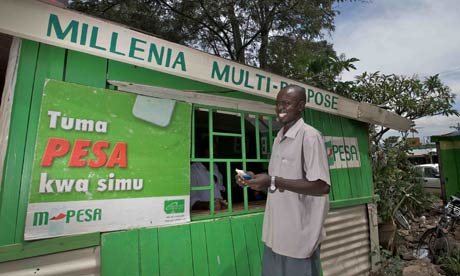
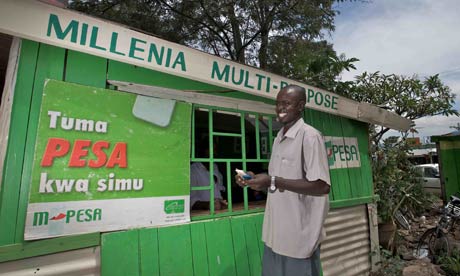
As stated here, according to Katrin Verclas of MobileActive.org, a website that monitors mobile technology used for social change, "the most successful commercial mobile projects aimed at the developing world will be hybrids, where commercial operators partner with NGOs and governments." Vodafone's M-pesa money transfer service is an example of how a private business has used local cultural knowledge and partners to bring 11 million customers to M-pesa (the word is derived from the Swahili for "cash"). "Vodafone worked with local mobile operator Safaricom, Citibank and the Commercial Bank of Africa to allow M-pesa users to send money safely and cheaply to their families without a time-consuming journey home. M-pesa also allows users to make cash withdrawals and loan repayments all using mobile phone technology."
Similarly crossing borders with mobile services, Nokia launched its Ovi Life Tools information service in India last year for agriculture and education as well as entertainment services. "Up to 1.5 million people have used Ovi Life Tools in the last 12 months, with agriculture and education information being the most popular. Subscribers pay the equivalent of less than $1 a month for constant agricultural information, while other services - such as learning English language - are around 50 cents a month each....'We have teams of experts providing information on many subjects, so we complement what NGOs and governments are doing,' says Jawahar Kanjilal, Ovi Nokia Life Tools global head of emerging market services. 'We provide personalised information and it is available 24/7. The NGOs cannot be in every village every day. Also, we provide more than what they can give.'"
The Guardian, July 18 2010. Image source: Vodafone
- Log in to post comments