










































Moving beyond the "Lump-Sum": A Case Study of Partnership for Positive Social Change
University of New South Wales (UNSW), Sydney (Bunde-Birouste, Bull); Mutual Sport (McCarroll)
Published in Cosmpolitan Civil Societies: An Interdisciplinary Journal (Volume 2, Number 2, pages 92-114), this paper examines the foundation of an integrated sport programme for positive social change and health promotion. It presents a case study of the relationship between a corporate sponsor (JP Morgan) and a community-based health promotion/social change organisation (Football United) in Australia. The paper articulates the various issues that arise in management of such a programme and the involvement of sponsors in its operation, specifically dealing with themes of corporate partnership and capacity building in the context of corporate social responsibility towards social change. The key feature documented is that corporate investment can move beyond abstract "lump-sum" social responsibility towards targeted contributions to detailed outcomes through sustainable and meaningful involvement in a health promotion framework.
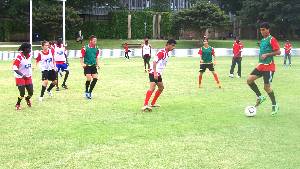
As detailed here, Football United is a grassroots approach using a football (also known as soccer) development programme to foster social cohesion within areas with high refugee settlement through leadership, skills development, mentoring, and the creation of links with a range of local community leaders and organisations. Football United was conceived as a health promotion/social change intervention run by the University of New South Wales (UNSW) School of Public Health and Community Medicine. Developed through a participatory community building health promotion methodology, it has expanded from a number of small-scale activities (camps, weekly community programmes) to include 8 regular school programmes, Saturday morning programmes, camps, large-scale tournaments, personal development programmes, and opportunities to represent Football United on a global scale. These programmes involve approximately 800 refugee, immigrant, and disadvantaged youth and children per year.
Through shared experiences and a passion for football (also known as soccer), Football United aims to encourage relationships, foster personal development and capacity building within communities, and mitigate the effects of both forced expatriation and resettlement on individual and community health and well-being. "Participation in sport can, if developed appropriately, can contribute to a sense of belonging, self-identity and social support....In terms of Football United, however, the leadership noted that community sport, as currently practiced, involves both inclusion and exclusion. Participation is either limited or not possible for many socio-disadvantaged youth due to a myriad of barriers such as financial, transport and logistical constraints. Football United's model of football for social development is therefore designed to play a part in addressing these wider issues of exclusion." On a secondary level, there are more specific objectives: to support and develop the ideal of football as a means for meaningful social change; to advocate solutions to the various problems faced by different refugee groups both in Australia and internationally; and to contribute to the academic literature on community-level health promotion/social change interventions in multi-ethnic settings.
Next, the paper provides a review of the literature examining the current refugee situation in western and southwestern Sydney and the role that sport can play in contributing to positive social change. A summary of literature relevant to the involvement of multi-factorial support and sponsorship in health promotion interventions completes this section.
Football United has had a multitude of contributors from various sectors, including JP Morgan, which has been working in partnership with Football United for more than 2 years (as of the time of this writing). A pre-existing mentoring relationship existed between JP Morgan Sydney's CEO [Chief Executive Officer] and the Principal of Granville South High School, which was part of the JP Morgan engagement with the Australian Business Community Network. This ethnographic study of Football United and its relationship with JP Morgan used participant observation and key stakeholder interviews for data collection.
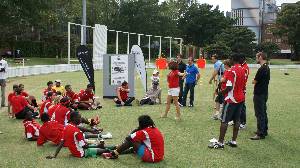
Specifically, as part of the partnership, between 10 and 20 youth are identified by the school on the basis of leadership potential and/or need for engagement and are then provided with coach training and accreditation. They deliver a weekly programme for years 7 and 8 within their physical education (PE) classes. The coach training, provided by Football United in partnership with the Australian Sports Commission, is run over 5 weeks prior to any coaching activities. Approximately 70 JP Morgan staff have been involved in the program as corporate volunteers. They have engaged in various activities, including fund raising, coaching logistics support, and mentoring.
An excerpt from the document follows:
...The Granville program has entered its second year of operation, already achieving significant goals. These include meeting program expectations, delivering further opportunities for students, and contributing to the school's reputation and involvement in the local community....While financial donations form the basis for the program's corporate sponsorship, the partnership between Football United and JP Morgan demonstrates that this arrangement can also include contributions through participation and organizational input by individual employees....Setting realistic goals for volunteering opportunities is important....Ongoing communication between Football United and the volunteer coordinator is also required, as is provision of education regarding the purpose of the program and the health problems being addressed. Finally, there needs to be definite structure to volunteering opportunities through role definition; this aids the actions of the volunteer coordinator and ensures purposeful and useful engagement of volunteers...
...This case study has been written to propose that an 'integrated partnership' between a corporate body and a social change organization can produce significant advantages beyond the scope of the typically uncomplicated financial contribution. This particularly involves more individual volunteering input from a corporate partner....It is important to appreciate that this study demonstrates a partnership that is ideal. The combination of aims and expectations has been matched with open communication and effective organization to create a relationship that is productive for both partners, whilst still furthering social and community outcomes."
Emails from Anne W. Bunde-Birouste and Tun Aung Shwe to The Communication Initiative on November 25 2010 and March 21 2013, and January 18 2011, respectively.

- Log in to post comments