










































Nonformal Dialogues in National Peacemaking
Peace Appeal Foundation
"Nonformal dialogues offer complementary approaches to formal dialogues in national peacemaking efforts in contexts of conflict."
With a focus on Nepal, Lebanon, and Myanmar (Burma) and other countries in South Asia, Southeast Asia, the Middle East, and Europe, this United States Institute of Peace (USIP) report looks at how national dialogues have arisen in part as a response to the growing emphasis on indigenous national responses to the challenge of conflict transformation and the ongoing effort to ensure that peacemaking processes are more inclusive. As exemplified by the experiences of national stakeholders in national dialogue processes examined in this report, nonformal dialogues are able to engage a broader range of stakeholders, including those marginalised or excluded from formal processes, and to extend their work over time, evolving to reflect changing societal concerns. They can provide valuable information and policy recommendations to governmental bodies and international organisations and are useful to sustain engagement when more formal processes have stalled.
This report first examines the historical record of dialogue processes and other consultative mechanisms, explains their recent evolution in conflict-affected societies, and distinguishes between formal and nonformal dialogues. As author Derek Brown explains, nonformal dialogues are distinguished from their formal counterparts (which they often complement) in the type and origin of their mandates, their less public character, types of participants (which may include those sidelined from, or who refuse to participate in, formal dialogues), their extended duration, and a generally smaller size. Nonformal dialogues tend to emerge in stages, usually involving a broader membership, such as the second-tier leadership of political parties. The mandates of formal processes, by contrast, are usually derived from agreements between governments and their opposing parties. Nonformal dialogues tend to be conducted out of the glare of media attention, whereas formal processes are more likely to attract significant media interest. Compared to formal dialogues, nonformal processes are more likely to affect official decision-making bodies indirectly, through the influence exerted by their members on decision makers and through informal relationships established between institutional players.
Brown then turns to the 4 main contributions that nonformal dialogues can make in peacebuilding and political reform processes: (i) building working relationships of trust; (ii) introducing new policy proposals; (iii) stabilising a process; and (iv) expanding engagement. With regard to the latter, the experience of Yemen illustrates the challenge of engaging the right stakeholders. Initially, Yemen's National Dialogue was widely perceived as among the most inclusive of official national dialogues convened in the wake of the Arab Uprisings. Its participants included youth, women, and representatives of the nation's major ethnopolitical factions. One underreported criticism was that despite the diversity of participants, specific representation from those parties that had the most political clout was poorly selected. Few of the top leaders of the Southern Movement, the Houthis, and others attended. Ultimately, as noted here, large swaths of Yemenis were skeptical of the dialogue and felt that it poorly represented their interests. This skepticism was one of the factors that contributed to the failure of the process.
Next, Brown examines the forms these dialogues take in the broader peacebuilding ecosystem, and discusses how institutional structures develop to support them. (These services may include: facilitating; conducting research; creating a knowledge-sharing infrastructure; providing administrative support, technical assistance, and training; offering financial support; and creating a secure physical space for holding meetings.) Drawing on the experiences of the multiple dialogues surveyed, he proposes 7 principles for launching and maximising the potential success of nonformal dialogues including, in brief:
- Understand the utility and the risks of the constructive use of ambiguity - For example, the Common Space Initiative in Lebanon was often perceived to be straddling the divide between government and civil society. This ambiguity provided breathing room that allowed the process to grow. However, ambiguity in nonformal processes can induce a perception of informality, which can lead to reduced commitment on the part of stakeholders.
- Recognise that credibility can depend on who convenes the dialogue and who is onvited to participate - To be successful, any long-term dialogue process must be able to adjust participation to fit its changing needs.
- Protect autonomy and promote national ownership - The sense of ownership of and commitment to a process can arise from multiple sources but is most often cemented by participation in the design process.
- Support dialogue through emphasising open inquiry and knowledge sharing - As a collective endeavor, these knowledge development efforts can simultaneously allow relationships to grow among participants, facilitate the open exchange of views, and lead to shared understanding - and even empathy - for adversaries and their positions, all building blocks for future agreements.
- Do not overlook the importance of physical design - As an example of how participants paid attention to physical design, 3 support structures in 3 countries had custom tables built to ensure that no seat at the dialogue table would be symbolically privileged over another.
- Create continuity: conceive of initiatives, not projects - All the nonformal dialogues and their support structures profiled here have been multiyear endeavors; one of the striking aspects of the cases examined in this report is the enduring commitment of their participants. In most of the cases profiled here, stakeholders have continued to participate in the dialogues for many years.
- Build bridges to achieve impact - The relationship between a nonformal dialogue, especially one that is national in scope, and official negotiation processes, existing legislative bodies, and other decision-making authorities is critical to its success.
The report also offers a distillation of 8 factors and questions for would-be organisers of nonformal dialogues to consider. For example, in the area of knowledge sharing, it is suggested that the organiser develop a plan for the regular and equitable sharing of information among participants by: assessing the technological proficiency and access of participants; assessing the nontechnological needs of prospective participants (for example, interpretation, translation, transportation); developing options to meet the anticipated research needs for stakeholders (for example, developing a physical and virtual library to provide access to publications, providing dedicated research staff); determining what technology infrastructure, both hardware and software, may be needed to share relevant information; developing a process for documenting and recording meetings in keeping with confidentiality requirements and determine how records of meetings will be archived and shared with participants; and considering what process principles and practices should be embedded in the dialogue's design to ensure routine sharing of knowledge.
Brown concludes with summary observations of the key features of nonformal dialogues, their evolving roles in societies emerging from violent political conflict, and the implications for their international supporters. One closing thought: "Nonformal processes are not without risks, nor do they guarantee results....There is no guarantee that...consideration and infusion of multiple voices will occur; nonformal national dialogue processes can be captured by elites, just as formal national dialogues have been. Still, engaging leaders from across social and political spectrums, including neglected and marginalized communities, can yield agreements and recommendations that, if not revolutionary, may nonetheless result in policies and new governance structures that are longer-lasting and more representative than prior political orders."
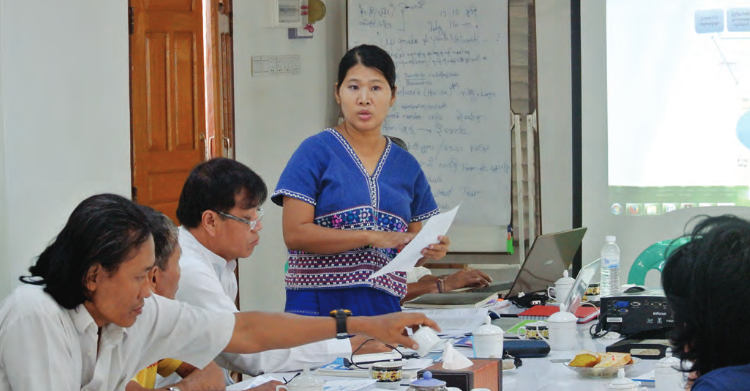
Communication for Development Network and USIP website, both accessed on November 27 2017. Image credit: Nan Mya Thida, © 2017
- Log in to post comments