










































Performance and Determinants of Routine Immunization Coverage within the Context of Intensive Polio Eradication Activities in Uttar Pradesh, India: Social Mobilization Network (SM Net) and Core Group Polio Project (CGPP)
"Targeted health communications are helpful in improving routine immunization performance. Strategies to address other determinants of routine immunization, such as religion and education, are also needed to maximize coverage."
Questions have arisen as to how the polio eradication effort in India may have affected routine immunisation (RI) programmes for polio and non-polio antigens. (For example, concerns had been expressed about shifting the time of primary health workers from duties such as RI to support polio eradication campaigns). However, this study found no evidence that RI services were disrupted by polio eradication efforts.
As this paper notes, since 1996, the United States (US) Agency for International Development (USAID) has provided support to the global polio eradication effort and has included the strengthening of RI systems as a core part of its strategy. One USAID-funded polio eradication project that follows this part of the strategy in India is the CORE Group Polio Project (CGPP). This paper explores the performance of RI services in the CGPP intervention areas concurrent with intensive polio eradication activities. It also explores determinants of RI performance such as caretaker characteristics and CGPP activities to strengthen RI services.
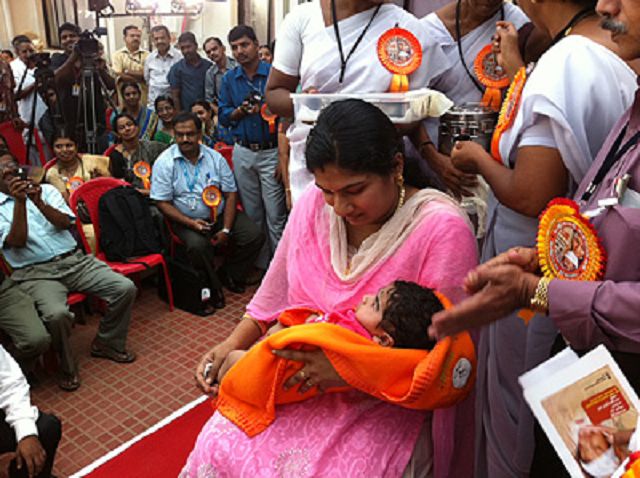
As detailed here, CGPP's SM Net was created in 2003 to work in the northern state of Uttar Pradesh (UP). The primary effort of the SM Net is carried out by a 3-level network of community mobilisers (community level, block level, and district level) who carry out activities such as ensuring that all children in their allocated households are given all childhood vaccines, in addition to oral polio vaccine (OPV). They do this by carrying out home visits to track all eligible children and explain the importance of RI to the mothers. Just a day before the RI session, the mobiliser distributes RI invitation slips to the mothers of eligible children. He or she also explains the importance of a Government RI Card that is completed by the auxiliary nurse midwife (ANM) after each immunisation is given. He or she gives a specially designed Congratulatory Card to all families with newborns; this card has key health messages in an illustrative format. Apart from this, RI Camps are held in high-risk areas, where it is the mobiliser's responsibility to ensure that all missed children are given the appropriate vaccine. The interpersonal communication (IPC) meeting with mothers and caregivers - especially with those who express resistance to polio vaccination - is a major community mobilisation coordinator (CMC) activity during the interval between mass vaccination campaigns for polio eradication. The CMC is equipped with various information, education, and communication (IEC) materials, including small games, behavioral charts, flip books, flash cards, storytelling, etc., that she uses both at IPC meetings and mothers' meetings.
The authors of this study conducted secondary data analysis of the latest project household immunisation survey in 2011 and compared these findings to reports of past surveys in the CGPP programme area and at the Uttar Pradesh state level (as measured by children's receipt of diphtheria, pertussis (whooping cough) and tetanus (DPT) vaccinations). This was conducted to judge if there is any evidence that RI services are being disrupted. They also modelled characteristics of survey respondents and respondents' exposure to CGPP communication activities against their children's receipt of key vaccinations in order to identify determinants of RI coverage.
One finding was that DPT1, a measure of access to immunisation, was affected by exposure of caretakers to IEC materials that promoted RI, and that were provided by CMCs at the same time the CMCs were promoting participation in mass polio vaccination campaigns. Specifically, exposure to flash cards promoting RI during mothers' meetings or home visits by CMCs predicts an increase in DPT1 coverage of about 4%. These mothers' meetings and home visits were a key strategy to encourage caretakers to have their children vaccinated with polio during an upcoming mass campaign. However, while these IEC activities were helpful in increasing access to RI, "IEC activities do not appear sufficient to achieve high levels of routine immunization coverage. Longer term relationships, between caretakers and local health workers who are supportive of childhood immunizations, appear more important and may reflect issues of trust in the health system. Strategies for promotion of immunization in this setting need to be tailored to the religious and education background of caretakers."
In short, results show that immunisation coverage "has improved considerably over time at the state level and in CGPP areas. This occurred during a period of intense polio eradication efforts as evidenced with the interruption of polio transmission by the end of 2011. In addition, immunization coverage appears higher in CGPP program areas compared to state averages, even though these areas have a level of intensity of polio eradication efforts greater than in the rest of the state."
BMC International Health and Human Rights, 2013 May 16; 13:25. Image credit: International Vaccine Access Center (IVAC)
- Log in to post comments