










































PMI Communication and Social Mobilization Guidelines: A Primer
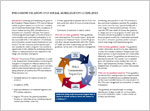
This short-form document on achieving and maintaining the goals of the President’s Malaria Initiative (PMI) and of national malaria programmes presents summary guidelines to assist in the development, implementation, and monitoring and evaluation (M&E) of programmes to influence behaviours and mobilise communities to create long-term behaviour change around the PMI interventions: correct and consistent use of insecticide-treated nets (ITNs), acceptance of indoor residual spraying (IRS), and adherence to treatment and prevention therapies, particularly during pregnancy.
The guidelines are directed to PMI country teams along with counterparts in National Malaria Control Programmes and other relevant departments within the Ministry of Health (MOH) and other partners who are working on programmes seeking to implement the following behaviours:
- Increased demand for malaria services and products;
- Acceptance of IRS;
- Improved adherence to treatment regimens and intermittent preventive treatment in pregnancy (IPTp);
- Regular ITN use by the general population, focusing on vulnerable groups including pregnant women and children under five;
- Prompt, appropriate treatment with artemisinin-based combination therapy (ACT) for children under five within 24 hours of onset of symptoms; and
- Community involvement in malaria control.
"The guidelines contain information about how to plan, implement, monitor, and evaluate a behavior change-social mobilization process to reach individuals and communities affected by malaria. The guidelines are structured as a planning framework. They explain how to establish goals and objectives, review existing data and conduct a rapid assessment, develop a strategy with a budgeted plan of activities, and monitor and evaluate the process."
"Step One: Planning and Strategy Development" summarises and exemplifies the point that messages must be developed for and focused on the intended audience. It recommends rapid assessment, as well as formative assessments, of the current behaviours of the audiences and their motivators in the planning stages of communication activities in order to compile and assess current knowledge, beliefs, practices, opinions, and other behavioural determinants.
"Step Two: Selecting Interventions: Objectives, Timing, Sequencing, and Frequency of Activities" describes the work of development of the communication strategy. It recommends: "PMI teams should work with MOH Information, Education, and Communication (IEC) [information, education, and communication]/Behavior Change Communication (BCC)/Health Education Unit (HEU), in conjunction with relevant MOH programs, to develop a comprehensive communication strategy." A chart on page 3 of the document provides tables for each of the PMI interventions and includes the desired outcome, assets, challenges, suggested approaches, rapid assessment techniques, and M&E approaches. Among the communication tools listed are the following: radio programming, TV spots, pictorial IEC materials, door-to-door campaigns and demonstrations, traditional media, story tellers, drama, puppetry, and job aides/point of purchase/service materials.
"Step three: Program Implementation" provides recommendations on implementation including: develop a checklist to review the specific communications activities and timing for preparatory work, communication activities, and follow-up; decide on sequencing; and develop a creative brief to describe the plan to partners and garner their agreement. It gives budget, capacity building, and programme integration ideas, including joint workshops on M&E and training of trainers. PMI communication activities can be used to strengthen integrated approaches at three levels, emphasising malaria prevention behaviours at each: "1) to improve health worker performance at the health facility; 2) for appropriate management of childhood illnesses at the community levels; and 3) to increase prompt, care-seeking behaviors; improve compliance with therapy for childhood illnesses, and provide additional nourishment during and after illness at the household level."
"Step four: Monitoring and Evaluation" focuses on programme implementation and process and output indicators, with an emphasis on evaluating BCC/IEC to demonstrate outcomes and highlight lessons learned to inform BCC/IEC policy and programmes. "PMI outcome indicators all have a behavioural component. For instance, the proportion of children aged less than five years who slept under an insecticide-treated net the night before a survey is equally dependent on household ownership and use behavior." Monitoring examines whether activities are on track, how closely they meet the proposed timeline and budget, and how staff perform. The document gives minimum M&E standards for communication-based activities, along with indicators and examples on page 5 of the document.
PMI website, March 17 2010.
- Log in to post comments