










































The Role of Information, Education and Communication in the Malawi Social Action Fund
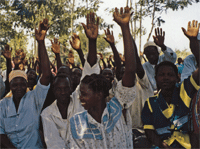
Malawi Social Action Fund (Chibwana); World Bank (Mohan)
Published in the journal Social Funds Innovations Updates, this 4-page report examines the effectiveness of the information, education, and communication (IEC) component of the Malawi Social Action Fund (MASAF)'s quest to foster community participation in economic development.
As detailed here, MASAF was launched in 1996 in response to concern on the part of the Government of Malawi that the country's self-help projects and programmes to date had not been notably successful in alleviating poverty in rural communities. It was designed to promote a change in the way all development actors, including (and, perhaps, especially) the government, would work with other stakeholders. With a comparatively high community contribution requirement (up to 20% of subproject costs), facilitating community participation was considered a key issue in project design. Public awareness-raising and IEC were the vehicles used to ensure that communities and other key stakeholders understood their roles, and were actively involved, in the MASAF approach.
This report explores in detail the various communication strategies associated with MASAF's IEC strategy. In short, a public awareness campaign using radio, bus advertisements, and posters was launched at the beginning of the project. In addition, visits by MASAF staff to key village and regional leaders were used to spread the word. A project launch presided over by the President of the Republic of Malawi was also held at one of the rural pilot subproject sites. Follow-up programmes - mostly using the medium of radio - were designed to reinforce the message that MASAF subprojects are for the whole community, not just the elite, and that implementation committees must remain accountable to the community. Then, during the microproject cycle, MASAF's strategy involves face-to-face communication; facilitators work intensively with the communities to see the subproject to completion. In turn, villages and local authorities give feedback to the facilitators on identifying IEC needs and gaps, public awareness message design, and advertising materials that the MASAF is considering using. For example, village-to-village communication is often how information gets out about MASAF activities. Some communities may have heard about MASAF but do not initially have enough information to formulate a request. A chief or other community member may then visit neighbouring villages already taking part in a MASAF-funded project to see for themselves how the project works. The MASAF beneficiary village then acts as a catalyst, helping neighbours learn more, with advice transmitted via radio interviews or cassette recordings.
Here are a few key points from the "Impact" section of the document:
- Organisers felt that the various waves of IEC initiatives (radio messages, posters, bus advertisements, interpersonal exchanges) established very clearly in the minds of prospective stakeholders the norms of the project, the roles they were expected to play, and their attendant responsibilities. This strategy was perceived to foster participation in the project.
- Reportedly, a clear impact of the equitable access to information was the distinct change in the attitude of economically poor communities towards both non-governmental organisations (NGOs) and the government's district extension staff. "With regard to the former, the communities made it clear that they were aware that NGOs were only one of the options they could utilise to help them in choosing, designing, and implementing their project - they would make the decision. Regarding the district administration, the attitude of the communities changed from passive acceptance of whatever was handed down to active participation in demanding, however politely, that the administration’s extension staff deliver their part of the bargain. In effect, power relationships began to be reshaped."
- "Within the community, where the elites had been generally unchallenged, free access to information about rights and responsibilities ( for example, the role of the project sub-committee) gave rise to pointed questions about the use of funds, the quality of materials purchased, the manner in which a contractor had been selected, etc.). Members of Parliament who attempted to influence procurement or contracting issues were, for the most part, kept at bay by the communities."
- "The fact that the project encouraged gender-focus was communicated widely - this helped women to insist that they should be part of project sub-committees and encouraged their active participation in influencing the decisions regarding the community's priority needs."
An excerpt from the "Lessons Learned" section follows:
- "An IEC campaign should precede project implementation to inform and shape opinion on project features.
- An IEC component helps a great deal in moving from an asymmetrical information environment to a symmetrical one...
- It is important to have an IEC professional in the Project Management Unit (or its equivalent)...
- Training in IEC needs to be provided to the project's first line of contact with communities...
- The first wave of messages must be clear and simple, and open to as little misinterpretation as possible...
- A communication initiative needs to follow up its first information campaign with a second wave of clarification...
- ...Community faith in MASAF was high because, unlike most other projects, very little time elapsed between hearing about the project on the radio and their being contacted.
- One of the best sources for an evolving IEC component is a Beneficiary Assessment.
- Regular dissemination of project experiences helps to reinforce the politically non-partisan nature of the project...
- Documenting and disseminating the experiences of communities, in print and on the radio, tends to restore faith in one's capacity to contribute to a solution, and to reinforce a sense of community between peoples across a country."
Findings, Africa Region, Number 30, July 1998; the MASAF website; and the Social Funds page on the World Bank website.
- Log in to post comments