










































Social Mobilization - Word of Mouth: Learning from Polio Communication and Community Engagement Initiatives
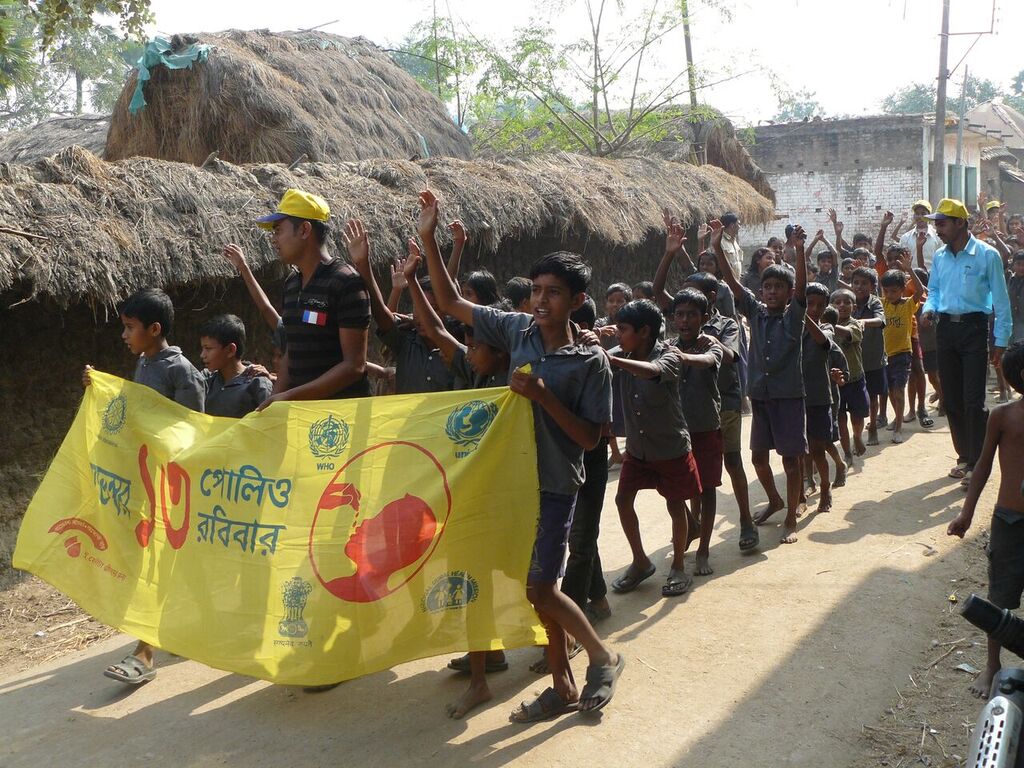
Social Mobilization
The process of people connecting and organizing in formal and informal networks at local, national, and global levels is the basis for social mobilization, a powerful driver of positive development. The Social Mobilisation Network (SMNet) in India, co-developed by the CORE Group and UNICEF, was hugely important in the successful action to eradicate polio in northern India. It also inspired similar networks in Afghanistan, Nigeria, and Pakistan.
The following data from research in Nigeria demonstrate that social mobilization is important, even when there is only a general connection to the issue in question—in this case, polio.
“We found considerably lower levels of propensity to refuse polio vaccination in communities where women participated more actively in public meetings. We do not know whether the effect is direct or indirect. But it points to the value of women’s empowerment and civic engagement as potentially powerful measures to support community engagement in public health activities. We found a similar and significant association between propensity to refuse OPV [oral polio vaccine] and male participation in public/communal meetings.”10
Polio-specific social mobilization strategies have paid particular attention to organizing at local levels, mapping, and cultivating a multi-pronged approach.
Emphasizing Local Engagement
Polio communication and community engagement strategies made significant efforts to facilitate dialogue with, and positive engagement of, community groups, traditional processes such as shuras, women’s groups, local leaders, religious leaders, and key academic and other local institutions to ensure that local perspectives and knowledge are prominent in decision-making. Involving local people in local neighborhoods in program efforts ensures a connection to the local decision-making and communication processes that are vital for effective action.
Mapping for Mobilization
The process of mapping facilitates and accelerates social mobilization. Work took place with local people to draw block-by-block maps in India that included: the number of children in houses; streets and houses that had been covered by vaccination campaigns; and identification of resistant houses, places of worship, health centers, schools, other public spaces, and community leaders, among many other elements. The maps provide a tangible focal point for engaging people, not just in building the map but also in asking the important “why” questions for local analysis. For example: “Why does this block have low vaccination rates?” “Why does the local map show many more children than the formal plan?” and "Why are there so few community meetings in that district?" The answers to these and other “why” questions made a significant contribution to improving program performance.
Developing a map also provides the basis for engaging different parts of a community, all of which can contribute something—for example, mothers can be a great source of local the insights and knowledge.
Maps were also used with line lists of newborns needing to initiate vaccination, community members/households refusing oral polio vaccine (OPV), and community members absent when revisited. These line lists helped to focus efforts to resolve such issues. As just one example, in Nepal, the CORE Group's geographic information system (GIS) was used to map the Terai before satellite image mapping was available. Each time a house was passed, a team member on a bike would send the coordinates to another person with a computer, who was following in a car.
This local mapping activity was complemented by a more general use of mapping in support of social mobilization. Supervisors had to produce a daily map that drew together patterns across multiple residential blocks or communities. Later, satellite imaging helped identify settlements that had been omitted from previous plans. Particular attention was paid to those areas that straddled district/provincial borders to ensure accuracy.
Multi-Pronged Strategies
Polio communication and community engagement infused social mobilization, from all angles, during vaccination rounds. There was a planned process to ensure that the conversations undertaken, knowledge shared, and leadership roles supported were in the full range of communication opportunities and included the voices of all social groups.
The polio program sought to identify and engage with local community groups (e.g., in community and mothers’ meetings), as well as at places of worship, within households, as part of political gatherings, through radio and TV (where appropriate), as an integral part of health centers, within cultural gatherings, in markets, on public transport, in barbershops, and within interpersonal conversations, wherever they take place. When consistently branded and produced with fewer words and more pictures, communication materials, job aids, social media, shared MP3 clips, mass media such as radio programs, public service announcements, and other media prompted and supported family and community conversations, learning, and decision-making.
The same principle applies to the people who are engaged in these efforts—mothers and fathers, cultural leaders, religious leaders, teachers, friends, neighbors, health workers, celebrities, athletes, journalists and other media, and politicians.11 Engaging youth through puppet shows, jugglers, and other forms of entertainment-education helped to make the polio program more inviting, especially when the risk for "fatigue" arose after so many rounds of vaccination.
The process of mobilizing the community is not a straight line. The CORE Group, for example, sometimes returned to the same home 20 to 30 times to answer questions before permission was granted to vaccinate the children with the polio vaccine. In the context of these and other pressures and expectations, interpersonal and negotiation skills are critical for mobilizers and frontline workers.
Polio communication and community engagement strategies—with their prominent focus on local mapping and a 360-degree approach—provided crucial learning for effective development action.
Editor's note: Above is an excerpt from the July 2018 paper "Word of Mouth: Learning from Polio Communication and Community Engagement Initiatives - Insights and Ideas to Accelerate Action on Other Development Issues", from the United States Agency for International Development (USAID)-supported Maternal and Child Survival Program (MCSP).
- Click here to return to the Table of Contents.
- Click here to go directly to the References page, where endnote information corresponding to the superscript numerals in the text above can be accessed.
Previous section - Background
Next section - Norms and Culture
Access the various parts of the document directly:
- Background
- Social Mobilization
- Norms and Culture
- Community-Based Surveillance
- Data-Driven Strategy
- Operational Oversight
- Conclusion
- References
- Acknowledgments
This paper is made possible by the generous support of the American people through the United States Agency for International Development (USAID) under the terms of the Cooperative Agreement AID-OAA-A-14-00028. The contents are the responsibility of the Maternal and Child Survival Program and do not necessarily reflect the views of USAID or the United States Government.
The Maternal and Child Survival Program (MCSP) is a global USAID initiative to introduce and support high-impact health interventions in 25 priority countries to help prevent child and maternal deaths. MCSP supports programming in maternal, newborn, and child health, immunization, family planning and reproductive health, nutrition, health systems strengthening, water/sanitation/hygiene, malaria, prevention of mother-to-child transmission of HIV, and pediatric HIV care and treatment. MCSP will tackle these issues through approaches that also focus on household and community mobilization, gender integration, and digital health, among others.
Image credit: Chris Morry
- Log in to post comments