










































Striving for Transformation through Empowered People (STEP)
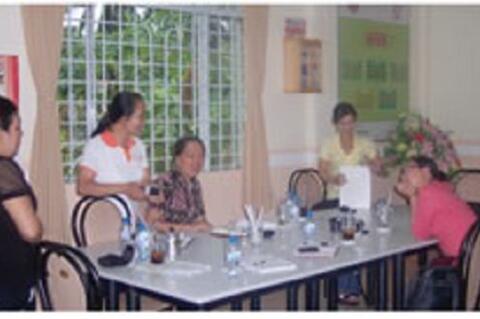
Implemented in Vietnam's southwestern province, the 4-year STEP programme (2008-2012) addresses gender and its effects on the behaviour and life choices of both men and women. The programme, a collaboration between CARE International in Vietnam (CVN), the provincial Department of Labor, Invalids and Social Affairs (DOLISA), and the Department of Social Evils Prevention (DSEP), provides support and health information both before and after rehabilitation to enhance the social reintegration of people who inject drugs (PWID) and sex workers (SWs). In particular, STEP seeks to ensure that both men and women have equal access to services to prevent sexually transmitted infections (STIs), safeguard their health, avoid gender-based violence (GBV), and participate in income-generating activities.
STEP draws upon two complementary strategies to prepare residents for release and to support them upon release. (After arrest, SWs and PWID may be confined to Social Education Labor Centers ("05 centres" for SWs; "06 centres" for PWID) for periods of up to 5 years for repeat offenders. The 05/06 centres are near Can Tho and An Giang ). Strategies include:
- A pre-release support programme (PRSP) - The staff at the 05/06 centres are trained to provide supportive counselling and basic health services to centre residents, in addition to the traditional sessions on the harms of drug use and sex work and optional courses in industrial knitting or sewing. When they leave the centre, returnees receive a "release package" that includes a t-shirt with the slogan "Determination and Victory", condoms, a post-release support services (PRSS) brochure, and a list of services available in their home community.
- PRSS drop-in centres are located in Binh Thuy district and Can Tho City, Can Tho province, and in Long Xuyen City, An Giang province. Members of PRSS staff visit residents at the 05 and 06 centres to introduce themselves and let the residents know about the services that will be available when they return home. The PRSS serve returnees who want counselling or referrals; social workers based at the sites conduct home visits to provide support and counselling to returnees who are having family problems or difficulties with reintegration. They also provide communication sessions with families and in the community to reduce stigma and discrimination against SWs, PWID, and returnees at the family level.
The 5-member CVN staff carry out training, technical support, and monitoring in collaboration with provincial DSEP and DOLISA staff. Former PWID and SWs, including former centre residents, were recruited to serve as PRSS staff members and peer educators to augment existing staff. STEP has trained hundreds of returnees in the community to act as peer outreach volunteers, who try to identify new returnees and encourage or accompany them to the PRSS for counselling and support.
HIV/AIDS, Gender.
For more details on all references cited below, please click on the "References" tab here: "Breaking New Ground", by Kai Spratt and Quach Thi Thu Trang, October 2011. Research indicates that HIV prevalence in Vietnam is not high relative to other countries, but it is highly concentrated within most-at-risk populations (MARPs). PWID risk HIV infection by sharing injection equipment and buying and selling sex. An estimated 200,000 PWID (82% of whom are men and 18% of whom women) account for about 65% of all people living with HIV in Vietnam (Needle and Zhao, 2010).
The 2006 Law on HIV/AIDS Prevention and Control endorses harm reduction programmes for PWID and stresses a behaviour change approach at the strategic planning and programmatic levels. However, this approach does not take into account that HIV risk behaviors are embedded in and reinforced by the risk-taking norms of social networks of SWs and PWID (Lamm 2008). Furthermore, Vietnamese society is heavily influenced by Confucian philosophy, which is characterised by male dominance and privilege, son preference, and hierarchical relationships that support gender inequality (United Nations Viet Nam, 2010). Social norms discourage discussion about sex or sexuality, which constrains opportunities for safe sex, reproductive heath choices, HIV testing, and other preventive actions. Violence against women is a fairly common and accepted practice in Vietnam, though it is not well documented (Gardsbane et al. 2010).
Current laws and policies frame sex work, drug use, and homosexuality as "deviant" behavioural choices (Ngo et al., 2009) and "social evils" that degrade cultural and familial traditions. Sex work and drug use are both illegal (whereas homosexuality is not); the threat of harassment and arrest heightens these groups' vulnerability by driving them to operate underground (Lam, 2008). After arrest, vocational training to prepare SWs and PWID for productive work is limited to gendered notions that sewing and weaving classes are the best job options for women, which few female centre residents take up. Consequently, rates of recidivism are high for former inmates of both 05 and 06 centres.
Recommendations from STEP's experiences so far include:
- Tailor the GBV component to the level of community understanding: GBV in this setting, and in Vietnam in general, is common (UNFPA Viet Nam, 2007) but unacknowledged. Reconciliation Committee members, and community-level organisations, and provide training in skills, strategies, and actions for discussing, responding to, and preventing GBV in the community. Progress could be tracked through a baseline and end-of-project randomised cluster survey sampling approach.
- Focus training on strengthening critical thinking about gender norms and their effects: Future training, mentoring, and supervision activities should introduce STEP staff and partners to exercises that help them think more critically about gender norms for both women and men, and how these norms influence not only stigma but also decision making on a wide range of issues, including reproductive health, STI prevention, treatment seeking, and livelihood opportunities.
- Support equitable business and job opportunities: Men and women should be encouraged to look at job opportunities based on their attitudes and interests, not their gender roles.
- Consider providing basic education: A step-wise approach, which offers basic literacy and financial education and then access to vocational training or a microfinance programme, might be appropriate.
- Increase the level of loan support for women.
- Strengthen monitoring and evaluation.
Email from Anna Lisi to The Communication Initiative on November 9 2011; and "Breaking New Ground", by Kai Spratt and Quach Thi Thu Trang, October 2011. Image credit: Kai Spratt
- Log in to post comments