










































Tostan (Breakthrough) Community Empowerment Programme (CEP)
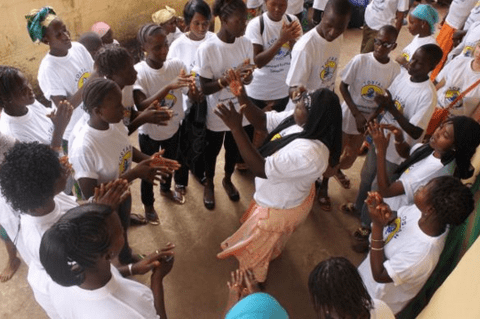
Established in 1991, Tostan, which means "breakthrough" in the Wolof language of Senegal and The Gambia, is a non-profit organisation based in Thiès, Senegal that works to empower African communities to bring about development and social transformation based on respect for human rights. The organisation runs programmes, such as village empowerment programmes, that work to end the practice of female genital cutting (FGC) in West Africa. The organisation combines traditional and modern techniques in an effort to bring about change on personal, community, and national levels.
Communication Strategies
With an approach based on human rights and on the African tradition of participation and respectful consultation, Tostan invites villagers to evening classes on democracy and human rights, health, and hygiene, as well as problem-solving and management. A number of teachers are deployed throughout Senegal to conduct the 30-month adult and adolescent programmes that teach through the use of stories, theatre, poetry, proverbs, song, and dialogue. These "Village Empowerment Programmes" aim to enhance women's life skills and improve their socioeconomic condition. Participants are asked to engage in sharing the information from each class with at least one relative. Proposals and demands for change are subsequently developed by villagers.
Organisers describe Tostan's strategy as refraining from imposing opinions or judgments on class participants on any given subject. That is, instead of directing participants to abandon the tradition of FGC, teachers explore and encourage alternative rites. For example, Tostan might draw on the work of Kenyan organisation Maendeleo Ya Wanawake, which has offered an "alternative rite" since 1996. Instead of undergoing FGC, girls receive family life education in seclusion and then a public graduation ceremony that recognises them as adults.
As soon as villagers in a public meeting have decided to try to put an end to FGC they make contacts with nearby villages to find out if they can interest them in participating in the project. When a group of neighbouring villages agree to abandon FGC, they come together to make a public declaration in which the villagers solemnly declare to abandon the practice.
Media, especially radio broadcasting adapted to local culture and in vernacular languages, is used to inform the general public about FGC and other issues raised by Tostan, with phone-in programmes used to help clarify what the project is about.
Tostan projects include the following:
Organisers describe Tostan's strategy as refraining from imposing opinions or judgments on class participants on any given subject. That is, instead of directing participants to abandon the tradition of FGC, teachers explore and encourage alternative rites. For example, Tostan might draw on the work of Kenyan organisation Maendeleo Ya Wanawake, which has offered an "alternative rite" since 1996. Instead of undergoing FGC, girls receive family life education in seclusion and then a public graduation ceremony that recognises them as adults.
As soon as villagers in a public meeting have decided to try to put an end to FGC they make contacts with nearby villages to find out if they can interest them in participating in the project. When a group of neighbouring villages agree to abandon FGC, they come together to make a public declaration in which the villagers solemnly declare to abandon the practice.
Media, especially radio broadcasting adapted to local culture and in vernacular languages, is used to inform the general public about FGC and other issues raised by Tostan, with phone-in programmes used to help clarify what the project is about.
Tostan projects include the following:
- Abandoning Female Genital Cutting (FGC): In 1997, a group of women from the Senegalese village of Malicounda Bambara stood before 20 journalists and declared their decision to end the practice, a centuries-old tradition in their village.
- Ending Child/Forced Marriage: By participating in modules on human rights and responsibilities, democracy, and health, Tostan participants learn about the universal human right to free consent to marriage. They also learn about the negative health consequences related to giving birth at a young age.
- Promoting Grassroots Democracy: Made up of 17 democratically chosen members, a Community Management Committee (CMC) serves as a model of democracy for the entire community. In addition to its other leadership responsibilities, the CMC works to increase democratic participation by encouraging residents to register to vote, obtain national identity cards, and participate in national elections.
- Enhancing Economic Opportunities: Tostan addresses unemployment and economic opportunities issues by providing villagers with capacity building in basic math, small project-management, and budgeting skills; opportunities to partner with local and international NGOs and lending institutions; and micro-credit activities. Tostan provides funds and training to micro-credit associations in selected villages. Small business projects have included the sale of staples such as sugar, oil, and millet; the production and sale of locally made soap, anti-mosquito lotion, fruit juices; collective projects such as community gardens and animal-raising cooperatives.
- Empowering Women and Girls: The organisation reports that female participants in the Tostan programme are proving that women can break gender barriers and take active leadership roles in their families and communities. Tostan classes foster dialogue in which men and women contribute equally to discussions regarding community affairs. According to the organisers, for many female participants, these classes represent the first opportunity they have had to voice their opinions before a group of men and women. Not limited to adults, adolescent girls lead movements for the protection of their human rights and speak out in public against female genital cutting and child/forced marriage.
- Improving Literacy and Math Skills: Tostan's Community Empowerment Programme (CEP) in national African languages exposes villagers to reading, writing, and mathematics.
- Sustaining the Environment: Tostan's modules on health and hygiene provide villagers with the necessary knowledge and skills to find creative solutions to the environmental problems in their communities.
- Preventing and Treating Malaria: In the Community Empowerment Programme (CEP) modules on health and hygiene, participants learn about the ways malaria is transmitted and strategies to avoid attracting the mosquitoes that carry the disease as well as proper treatment methods.
- Promoting Girls' Education: Community Management Committees (CMCs) lead campaigns for school registration, urging parents to enrol their children and often going door to door to register them. Many villages experience an increased school enrolment rate for girls in the years following the programme. In areas that lack school facilities, many communities have devised formal petitions to the government to request the construction of one.
- Protecting Maternal and Child Health: Tostan's Community Empowerment Programme (CEP) teaches simple and sustainable ways that communities can improve maternal and child health. In Tostan classes, participants learn a number of relatively easy ways to greatly reduce the risks of disease and death for children and adults. For example, participants learn the importance of washing hands and dishes with soap, treating drinking water with bleach, and regularly cleaning around wells and water pumps.
- Protecting Children's Rights: Tostan's programme has produced community efforts to protect children's rights. This includes the protection of thousands of young girls' uman rights to health, bodily integrity, and freedom of choice through the abandonment of female genital cutting and child/forced marriage.
Development Issues
Health, Gender, Women, Youth, Economic Development.
Key Points
Tostan's mission is "to contribute to the dignity of African people through the development and implementation of a non-formal, participatory education programme in national languages. It provides women with knowledge and skills to become confident resourceful actors in social transformation and economic development of their communities."
According to the organisation:
According to the organisation:
- since its inception in 1991, Tostan has implemented the CEP in over 2,600 communities in nine countries in Africa.
- since 1997, 3,548 villages in Senegal, 298 in Guinea, and 23 in Burkina Faso, as well as villages from three other African countries, have joined the women of Malicounda Bambara in abandoning FGC practice.
- To date, over 2,460 communities in West Africa have collectively abandoned child marriage and FGC through public declarations.
- Tostan has trained over 1,000 CMCs in Senegal, 133 in Guinea, 42 in Somalia, and 40 in the Gambia. These CMCs meet monthly and keep records of their activities. Over 60 CMCs in Senegal and 113 in Guinea have received official government recognition as civil society organisations.
Partners
Population Services International, the World Bank, Africare, Family Health International, and Canadian Development Funds, Agencia Español de la Cooperación Internacional, American Jewish World Service (AJWS), The Annenberg Foundation, Anonymous Donor, Banyan Tree Foundation, The Bill and Melinda Gates Foundation, Communidad de Madrid, The Jacob and Hilda Blaustein Foundation, The James R. Greenbaum, Jr. Family Foundation, Just World International, The Sigrid Rausing Trust, The Swedish International Development Agency (SIDA), UN Foundation, UNFPA, UNICEF, United States Agency for International Development (USAID), Wallace Global Fund, and Wallace Research Foundation Agency.
Sources
Press release written and forwarded by Peter Erichs of Sida to The Communication Initiative on June 22 2005; and Tostan website on July 23 2009 and April 20 2021. Image credit: Tostan
- Log in to post comments