










































Women's Use of the Sada in Afghanistan: Dissemination, Dialogue, and Transformation
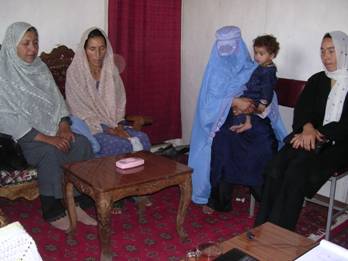
"Our analysis suggests that Sada facilitated dialogue, participation and action. Empowered by information, women participated in the elections in large numbers, becoming active agents of change. At the household level, women increasingly found the courage to speak up and, where possible, negotiate their rights. By receiving relevant and timely information, women were motivated to participate as equals with men in both public and private realms. Clearly, women's use of Sada led to widespread dissemination of knowledge of women's rights and civic responsibilities, raising possibilities for gender transformations in other aspects of social and community life."
This 35-page report investigates the incorporation of gender issues into a civic education initiative carried out in Afghanistan by the United-States-based non-profit humanitarian organisation Voice For Humanity (VFH) (and funded by the United States Agency for International Development, or USAID). In concert with its mission to assist oral communicators (non-literate people) around the world live longer and more productive lives through access to information, education, and training materials, VFH distributed 41,000 solar-powered digital audio players containing civic and voter education information in 21 Afghan provinces prior to the September 18 2005 parliamentary elections. These players, called Sada (or voice, in the Dari language), included 15 hours of dramas, songs, and other materials on peace, national unity, democracy, civic engagement in the election, women's rights, and other development and health issues. Each kit included a small speaker for group listening and a solar charger.
The evaluators stress the role that attention to gender concerns played in the development of this initiative. They claim that concerted efforts were made to ensure that women would personally receive the Sada device; the women's players were distributed through women's networks (e.g., women's shuras that were housed at provincial women's centres). Training sessions were held to ensure that women were able to operate the technology. Because focusing the project solely on women might have spurred male alienation and resistance to the messages, VFH provided the same audio content to both men and women. However, different coloured Sadas were created for men (silver) and women (pink) as a means of preventing men from taking women's Sadas.
The authors of this report highlight the fact that the use of this medium was part of a purposeful strategy for reaching both men and women in Afghanistan's traditional and patriarchal culture. They explain that women in this country were excluded from public society during the Taliban regime, and continue to have less access than men to employment, health care, education, and information. Reportedly, Afghan women (especially those who are economically poor) may be illiterate, may shoulder heavy household burdens, may have restricted mobility, and may be forced into early marriages. Furthermore, many have been left out of information and awareness-raising efforts because men predominantly control access to media; scarce electrical power supplies further limit women's use of media.
In this context, the report examines men's and women's perceptions of the Sada device and their patterns of adoption and use as part of a larger strategy for using communication to empower people through political participation. They explore how women received Sada, the manner in which they shared it with their family and friends, and how the technology spurred dialogue and contributed to transforming and challenging gender norms in Afghan society. The authors contend that this research "makes a case for how women's access to information challenges and contributes to transforming gender structures in society."
Specifically, this study (conducted in October 2005) sought to understand how listening to the Sada affected women - particularly their perceptions of, and participation in, the elections. Researchers interviewed 32 men and 83 women who were Sada users, trainers, and distributors in Wardak, Parwan, Kapisa, Paktya, and Logar provinces. Results of this research process are summarised below:
- Access - Researchers found that the Sada was readily accepted by both women and men and shared widely with other community members. For instance, women reported that they continued to listen to the programmes even after the elections. This could be due, in part, to the fact that (as researchers learned) they found the information easy to understand, the language appropriate, and they appreciated the fact that the Sada is solar-powered.
- Learning - Sada reportedly sparked engaged learning about civic rights and responsibilities, e.g., women's rights, education, and employment. For instance, in Afghanistan (where the illiteracy rate is high), the Sada device was found to be effective in providing listeners with information that they perceived to be relevant and useful. Researchers explain that "Most of our respondents had heard about the parliamentary elections but were unclear about how to enact their civic roles responsibly. The Sada explained and clarified the electoral process to them."
- Dialogue - Participants felt that the Sada created a collective space for discussing civic and human rights. Women who participated in the study indicated that they listened to the devices with their families and with neighbours, and that male relatives often joined in; according to researchers, this collective listening led to discussions about programme content. Women who utilised the Sada device were found to be more confident about discussing their rights with other others - both male and female. One woman from Wardak noted: "Now we understand our rights through Sada. So when we see any women in trouble we can go and discuss things and tell them that this is the right way. And these are our rights." As another respondent explained, "Before, we would accept everything that men told us to do. But now we understand our rights. We know whom we should vote for and how important education is. We learned a lot and now can discuss these things with our brothers, husbands, and fathers."
- Attitudes - Researchers indicate that they "found perceptual changes in the general attitudes of Afghan men toward women and a somewhat increased consideration for women's welfare. Several women spoke about how their husbands and fathers, after listening to Sada, became more open minded about what women could or could not do in Afghan society. Respondents also described a change in attitude among Afghan men and women with respect to early and forced marriages of young girls; they increasingly recognised that their daughters should be at least 18 years old when married, and should have finished their education prior to doing so. "This sentiment was echoed vociferously in all five of the study provinces, even among the older generations of men and women." One woman noted that her family listened to Sada together, and that, as a result, her husband changed many of his views: "Before hearing the program he would not have given me permission to go out alone, but now he lets me. This is a big change for us...He allowed our daughter to go to school."
- Action - According to researchers, "[t]he powerful testimonies of respondents signify changes in women's and men's intentions to change their behaviour regarding women's role in Afghan society." In part, this conclusion is based on the belief that the very act of expressing one's demands indicates empowerment: "Increased knowledge and comprehension of their rights and responsibilities spurred various women to question traditional gender norms." Several women respondents indicated that having knowledge of their rights enabled them to demand their rights. Shayla, a woman respondent from Logar, explained: "We heard about women's rights from Sada. In the program they talked about how we have freedom. We want our freedom and we want to work outside the home." The evaluation also cites behaviour shifts in terms of enhanced political participation on the part of women as a consequence of listening to and discussing the contents of Sada. Here is a quotation that illustrates this finding: "Almost all of our respondents gave credit to the Sada programs for encouraging them to vote: 'We went to the voting centre and voted. Sada helped us decide to vote'. We didn't know we could vote earlier.' A male respondent in Parwan emphasized that Sada helped convince several men to allow their wives to vote. With a proud and beaming smile, he announced: 'Not just my wife, but all the women in my village voted.'
Based on such evidence, the researchers conclude that "VFH's Sada initiative in Afghanistan represents an exemplar of how information dissemination, spurred by a suitable technology, the Sada can lead to improved family and community dialogue. Such dialogue, coupled with a more enabling environment for women's concerns, can lead to gender-sensitive decisions, actions, and transformation." They indicate that key elements to this success can be linked to the fact that the device in question involved no associated costs, did not require literacy skills, could be listened to while engaging in household chores, and did not require women to leave their homes. In short, "Though information dissemination has been criticized by some because it views women as passive beneficiaries (Melkote & Steeves, 2001), VFH's Sada project reaffirms the role of information dissemination in gender and development initiatives. The respondents' voices provide ample support that information served as a catalyst for Afghan women to realize other societal rights, thus contributing to empowerment."
Editor's note: A related article was subsequently published in the August 2007 issue of the International Communication Gazette. Click here to learn about how to access (subscription required) this article, which is titled "The Sada Says 'We Women Have Our Rights': A Gender Analysis of an ICT Initiative in Afghanistan".
"Transforming Traditional Gender Structures: Giving Women Access to Information Technology" Mazi 11 - May 2007, sent via email to The Communication Initiative on May 31 2007; VFH website; emails from Corinne Shefner-Rogers and Arvind Singhal to The Communication Initiative on December 19 2007; and emails from Ami Sengupta to The Communication Initiative on December 20 2007 and January 17 2008.
- Log in to post comments