










































Improving Communication about the Uncertainty of Clinical Trial Outcomes: Using the Collaborative Production of Song to Facilitate Dialogues between Communities and Clinical Staff about the Risks and Benefits of Research in Johannesburg
Wits Reproductive Health and HIV Institute, Witwatersrand University (Stadler, Delany-Moretlwe); Institute for Development Studies, Sussex University (McGregor)
This document describes and evaluates a South African project that demonstrated the use of culturally expressive forms - in this case, a locally developed musical style - as a vehicle for promoting dialogue between medical researchers and the public. With Wellcome Trust funding, the Wits Reproductive Health and HIV Institute (WRHI) developed a collaborative participatory process using a local South African musical art form called Kwaito to improve the ability of clinical staff to communicate the uncertainties associated with the outcomes of clinical trials of new medical technologies, given the hypothesis-driven nature of their design as scientific experiments. WRHI used insights gained from the evaluation of the method of a song and the process of developing and using it to plan more effective future engagement with trial participants and their communities.
As researchers explain, HIV prevention clinical trials are undertaken in "contexts of distrust of medical research, where communities are research-naïve and vulnerable, and stigma constrains public discussion about HIV and AIDS. Clinical trials are also extremely uncertain experimental undertakings. This context poses particular communication challenges for clinical trials in recruiting, enrolling and retaining participants in trials, and particularly in disseminating research results."
WRHI managed a South African site (Orange Farm and Soweto, in the greater Johannesburg area) of the international Microbicide Development Programme 301 (MDP301). The MDP301 trial tested the efficacy and safety of Pro2000 in preventing the acquisition of HIV through sexual intercourse. Women were randomised to one of three arms: a gel containing 2% Pro2000, 0.5% Pro2000, and a placebo. All women were given condoms and risk counselling. They were also provided with contraception and counselled against becoming pregnant. Each participant remained in the trial for 12 months.
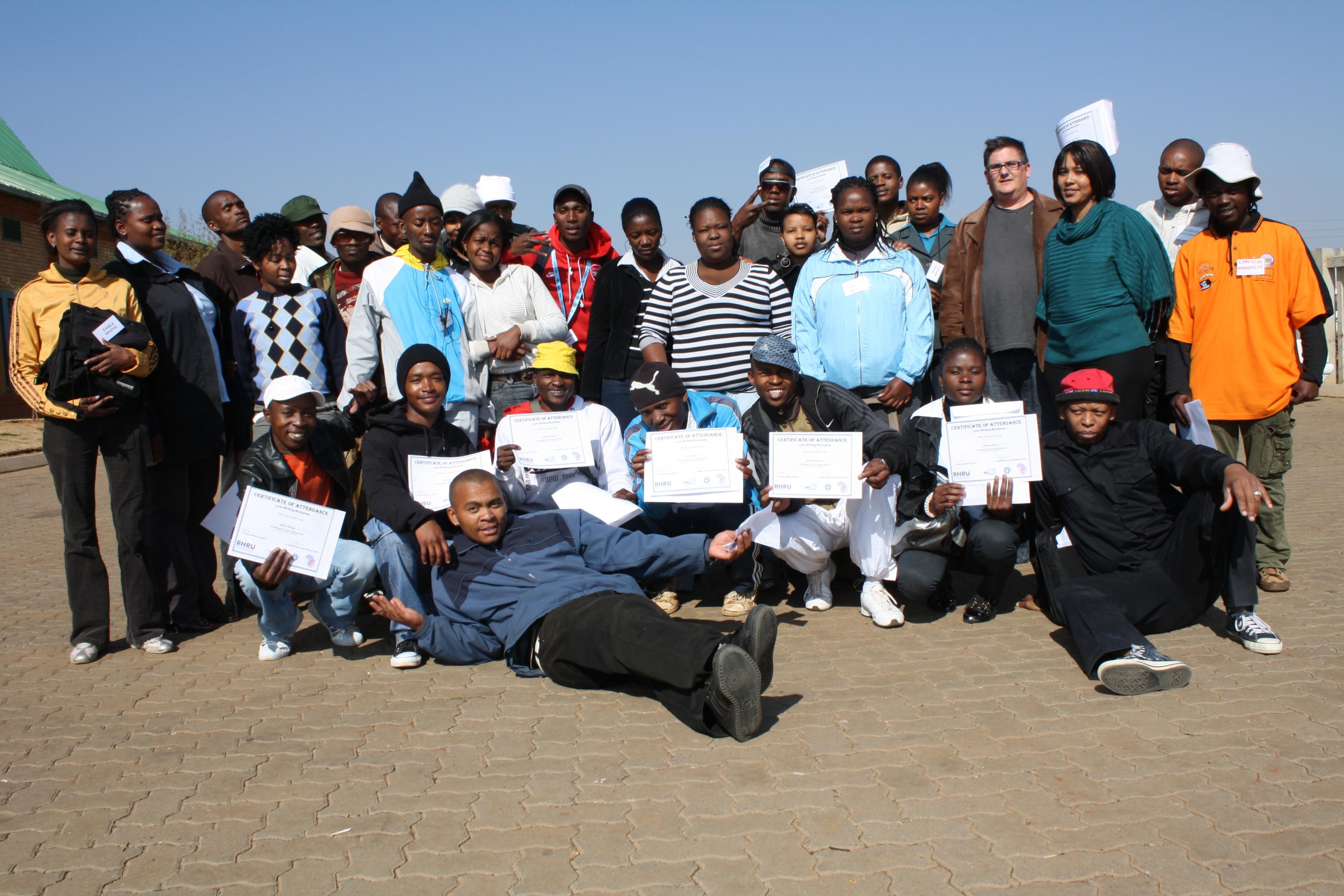
The project employed the Kwaito music style to engage local communities in the issues of concern to the research. Kwaito music is a popular genre in South Africa amongst young people of a similar background to those who participate in HIV prevention research. The project began with a collaborative lyric development workshop involving local aspiring musicians and former clinical trial participants, held over a 5-day period. The workshop, facilitated by a well-known Kwaito musician and members of a local theatre company, had the following objectives:
- To communicate the experiences of women who participated in the trial to the musicians and to promote dialogue between all workshop participants including the trial staff;
- To create a dialogue between the musicians and the trial participants;
- To construct dominant themes from trial participants' accounts into lyrics; and
- To instruct workshop participants in the basic elements of writing lyrics for music, to provide them with an introduction to Kwaito music as a performative genre, and to expose them to the basics of recording music.
The workshop resulted in the production of several draft lyrics, which were then put to music and professionally recorded using the voices of several of the workshop participants. An excerpt from the lyrics: "Hello! PRO2000 ~ Make love, try to prevent ~ The thing that is killing the nation (HIV), use the condom ~ The helper of lives ~ The condom saves lives ~ Hello, hello, let's go" The final cut was broadcast regularly on community radio stations - Jozi FM and Thetha FM during a radio slot reserved for discussion of clinical trials and health issues ("Tshireletso Health Talk"). In addition, those who participated in the song-writing workshop were invited to discuss the song on air. The song was also played at the final results dissemination meeting for the clinical trial in December 2009 and at other outreach events for the clinical trials research group during 2010. Later, the song was used as a jingle for a radio play (a subsequent Wellcome Trust project).
The aim of the evaluation was to assess whether the project stimulated local dialogue about the risks and benefits of clinical trial research, as well as whether insights have been gained to improve the communication around scientific uncertainties inherent in the outcomes of medical research. The evaluation of the project drew on three data sources:
- Observation notes recorded during the song writing workshop: Researchers from WRHI participated in the workshop and were tasked with taking notes during the general sessions and group work. Research staff recorded the conversations, noted the written and verbal lyrics, and observed participation dynamics.
- Focus group discussions (FGDs): FDGs took place in the month of July 2010, almost one year following the workshop. Former MDP trial participants were selected from a list of those participants who had attended the lyric writing workshop and those who had attended the MDP results dissemination meetings. Musicians who had participated in the workshop were invited. Six FGDs were held; 4 of these were for former trial participants and 2 were held for musicians and performers. The number of participants in each FGD ranged from 5-8 participants. The FGDs focused on: the process of the song-writing workshop and recordings (particularly for musicians); the exposure to the song on the radio and dissemination meetings; the relevance of the message of the song for the trial; the use of Kwaito as a performative genre; and the song's role in stimulating conversation and discussion about clinical trials.
- Interviews and observations at results dissemination meetings: Six meetings were held in December 2009, during which MDP301 participants were invited to hear the outcome of the trial. Pro2000 was shown to have no effect in preventing HIV infection, although it was found safe to use. Researchers ask: "Has such a result left participants disillusioned and did they feel prepared for a scientific result indicating no benefit? On the other hand, do they possibly have other perceptions regarding the less obvious and expected 'benefits' that they might have gained from participation that would not be immediately evident to medical scientists? These questions are salient to considering ways of improving communication about the nature of scientific hypotheses, in that a trial can have a range of outcomes, one of which can be that a new technology has no efficacy despite hopes. The questions are equally relevant to exploring ways of creating a dialogue about perceptions of risks and benefits in clinical trials." WRHI staff observed the responses of the trial participants to the results and held on-the-spot interviews with participants to gauge their feelings about the results.
Another series of questions and reflections: "Did the song promote a local discourse about trials, and if so what are the core messages contained within this discourse? Having reviewed the data collected over the past year we suggest that the production of the song and its broader dissemination using radio and participant meetings stimulated a more open discussion and debate about sexuality, AIDS and clinical trial research for HIV prevention. However, the stated aims of dealing with and communicating the uncertain nature of clinical trial research was not effectively communicated through the song itself. Instead the singular message of the lyrics are anticipatory, asking women and men to wait or 'hold on' for the results, which it is implied, are going to be positive. Although the workshop participants, particularly the former trial participants, recognised and talked about experimental and uncertain nature of the clinical trial and the drug itself, in the process of the development of the song these sentiments were drowned out by the musicians and the musical producer. Thus, the final lyrics contain only one line stating that the prevention method has not been proven."
Researchers note that the research places emphasis on the ethical obligations associated with communicating the results of trials, an area that often receives less attention.
Elements that they note worked well:
- The use of multiple voices in the production of the song: "Involvement in the process of making the song encouraged conversations about AIDS, sex and the clinical trial process itself. It was able to do this effectively because of the use of women's voices both in the stories that were recounted in the workshop and as vocalists in the song. The lyrics of the song are based on the experiences of former MDP301 trial participants. Women who participated in the workshop communicated what it meant for them to be in the trial and engaged the (predominantly) male musicians and WRHI staff in their accounts."
- Participatory approaches: "An important aspect of the production of the song is its participatory nature. Participatory approaches may be well utilised in the communication and the creation of dialogue around the outcomes of clinical trials....Participatory methodologies are thought to be particularly effective in situations in which power imbalances are stark, and critical dialogue may be concealed or repressed. Rather than focussing solely on the outcomes of research, participatory research methods emphasise the process of data collection. The methods used involve local people and incorporate local or emic knowledge....This helped to promote a dialogue between women and musicians and staff about trials."
- Breaking silences: "The song project was important as a medium for communication was in breaching silences and self censorship. As others have noted elsewhere, music and song are often ways in which conversations about taboo and censored subjects are prompted. Music, art and oratory are often used as mediums for the expressions of fears and anxieties about issues such as AIDS....Local cultural expressive forms can be used productively to communicate messages and stimulate debate."
- Using Kwaito as the medium for the song: "Our sense is that kwaito was the ideal musical genre to use because of its ability to openly discuss issues that are usually obscured or denied in everyday language. In the focus groups participants drew attention to the fact that the song communicated issues about the HIV/AIDS epidemic as well as women's sexuality. These are subjects that are public secrets and seldom discussed openly, except in gossip and rumour, resulting in secrecy and suspicion..."
Practical recommendations:
- "The song has the potential to promote local discourses about medical research. However, a song in itself cannot be used to educate people about medical research. The song has potential to be used in the context of other methods, such as drama and talk shows broadcast on community radio.
- The process needs to be participatory and include trial participants, medical researchers and musicians in forming the final product. However, we also recommend more time spent work-shopping the lyrics with trial participants and local aspirant musicians before the intervention of a professional musical producer who may have a limited understanding of the clinical trial and the intentions of the song.
- The process of producing a song can be duplicated at a lower cost and with greater involvement of local musicians and music production houses...
- Finding the balance between creative song writing and focussing on the core message is complex and requires input from all key actors throughout the production process. In future exercises it is recommended that the researchers insist on retaining the focus on the trial rather than on HIV prevention in general.
- Involving former trial participants in the process is vital...
- A good relationship with local radio stations and an agreement with them to broadcast the song are essential."
To inquire about accessing this document, please see the contact details, below.
"International Engagement Awards: Projects funded in 2009" [PDF]; and email from Jonathan Stadler to The Communication Initiative on January 25 2013.
- Log in to post comments