










































National Coalition for Dialogue & Deliberation (NCDD)
The core component of this initiative is the interactive NCCD website, which features links to information on organisations, discussion forums, events, newsletters, and publications. The idea here is to use information and communication technology (ICT) to foster D&D, which NCDD characterises as "powerful group processes that help people bridge gaps, make better decisions, take collective action, resolve conflict and become more active citizens." Through its website - as well as through in-person conferences and award programmes - NCDD provides resources, networking opportunities, and projects for what the organisation describes as "a growing community of practice dedicated to solving group and societal problems through honest talk, quality thinking and collaborative action."
Specifically, among the technology-centred features of the NCDD website and NCDD activities are:
- The Learning Exchange - a collection of over 3,000 resources on dialogue, deliberation, and public engagement featuring discussion guides, films, articles, processes, names of organisations, and other resources;
- Community News & Perspectives Blog
- Affinity Groups and Regional Networks - listservs for several affinity groups, including: those interested in higher education, new practitioners, and those looking into working in the field of D&D.
To access a page providing orientation and access to these resources, click here.
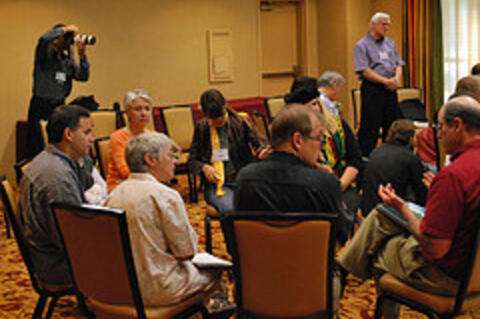
NCCD also draws on face-to-face interactions, as illustrated by its Mentorship Program. Developed to meet the needs of young people and others who are entering the D&D field and are in need of guidance and support, this programme pairs new practitioners with more experienced D&D practitioners, scholars, and activists who are established in the field. In addition, NCDD runs what it describes as "high-energy, highly participatory events which bring together practitioners, scholars, public leaders, trainers, artists, activists, teachers, and students....We have now held four...biennial national conferences, involving nearly 1,400 people from dozens of different countries." Often, the arts - e.g., drumming, singing, spoken word, theatre, the visual arts, music, dance, and film - are integrated into these events; this is based on NCCD's conviction that "[a]rt can be a powerful catalyst for and component of dialogue." For further details on these and other conference strategies and outcomes, click here.
Conflict.
According to NCCD, D&D are used for a variety of reasons: to resolve conflicts and bridge divides, to build understanding about complex issues, to foster innovative solutions to problems and launch action, and to reach agreement on or recommendations about policy decisions. NCCD explains that dialogue is a process that allows people, usually in small groups, to share their perspectives and experiences with one another about difficult issues such as racial disparities, youth violence, and gay marriage. The goal is to dispel stereotypes, build trust, and enable people to be open to perspectives that are very different from their own. Deliberation is a closely related process that emphasises the use of logic and reasoning to make decisions about public issues like health care and immigration. D&D processes tend to use skilled facilitators and carefully constructed ground rules or agreements to ensure that all participants are heard and are treated as equals.
NCCD indicates that people who are based outside of the United States are encouraged to become members of the coalition (this is a fee-based membership, although many of the resources available on the website are free to anyone, member or not). NCCD explains that "[s]ome people have expressed concern that we are limiting ourselves - and leaving out important practitioners, organizations, scholars and activists - by calling ourselves a "national" coalition. From the start, though, we felt it was important for us to establish ourselves and make an impact within the U.S. before striving to be - or claiming to be - an international organization." NCCD also encourages and supports leaders internationally who wish to initiate D&D coalitions in their own countries/contexts.
NCCD website; and emails from Joy Garman and Sandy Heierbacher to The Communication Initiative on June 28 2007 and November 17 2008, respectively.
- Log in to post comments